



Payment rails are the underlying digital infrastructure that allows money to move from a payer to a payee. Just as physical rails support a train, these systems support the flow of value.
The global landscape of moving money is undergoing a generational shift. For decades, the movement of capital relied on a complex web of correspondent banks and legacy messaging systems.
However, a new era of payment rails is emerging, characterized by instant finality, programmable compliance, and significantly lower operational costs.
Today, according to recent industry analysis, the US dollar and traditional systems are facing increased competition from alternative rails emerging from other countries, enhancing the role of other currencies within specific regions.
Alternative payment rails like blockchain technology, stablecoins, digital currencies and cross-boarder payment are reshaping global commerce with unprecedented speed and cost advantages.
What makes blockchain rails transformative it’s the ability to encode and automatically enforce payment rules at the ledger level.
Built on decentralized ledger technology, smart contracts automate complex payment logic, releasing funds when conditions are met without manual intervention.
Smart contracts are also utilized for atomic settlement: linking two assets to ensure that the transfer of one asset occurs if and only if the transfer of the other asset also occurs. This is often used in payment versus payment in a foreign exchange transaction.
Blockchain network transfers cost fractions of a penny while traditional wire transfers incur significant fees across multiple intermediaries, settle in minutes rather than days, and operate continuously without banking hours restrictions.
Enterprise blockchain has moved from experiment to production, with JPMorgan's Kinexys platform processing over US$2 billion to $7 billion on daily transactions.
The GENIUS Act (Guiding and Establishing National Innovation for U.S. Stablecoins) marked a turning point by establishing three pillars:
This allows companies to use stablecoins for immediate B2B payments such as USDC, settling global transactions at near-zero cost and eliminating the volatility risk that affected first-generation cryptocurrencies.
With over 130 countries currently exploring digital currencies, the shift toward programmable, government-backed money is built on three fundamental value propositions:
While the US remains a cornerstone of the financial world, some of the most significant innovations in real-time payments are happening in developing economies, particularly in Asia and Latin America.
The APAC region is currently winning the race for real-time payments. Countries like India (with UPI) and Singapore (with PayNow) have created ecosystems where instant transfers are the default, not the exception.
The regional push is now toward Project Nexus, a blueprint designed to connect these instant systems for 60-second international transfers across Asia.
Latin America has become a global benchmark for payment innovation. The region operates on a "multi-rail" approach where businesses combine traditional networks with high-velocity local systems:
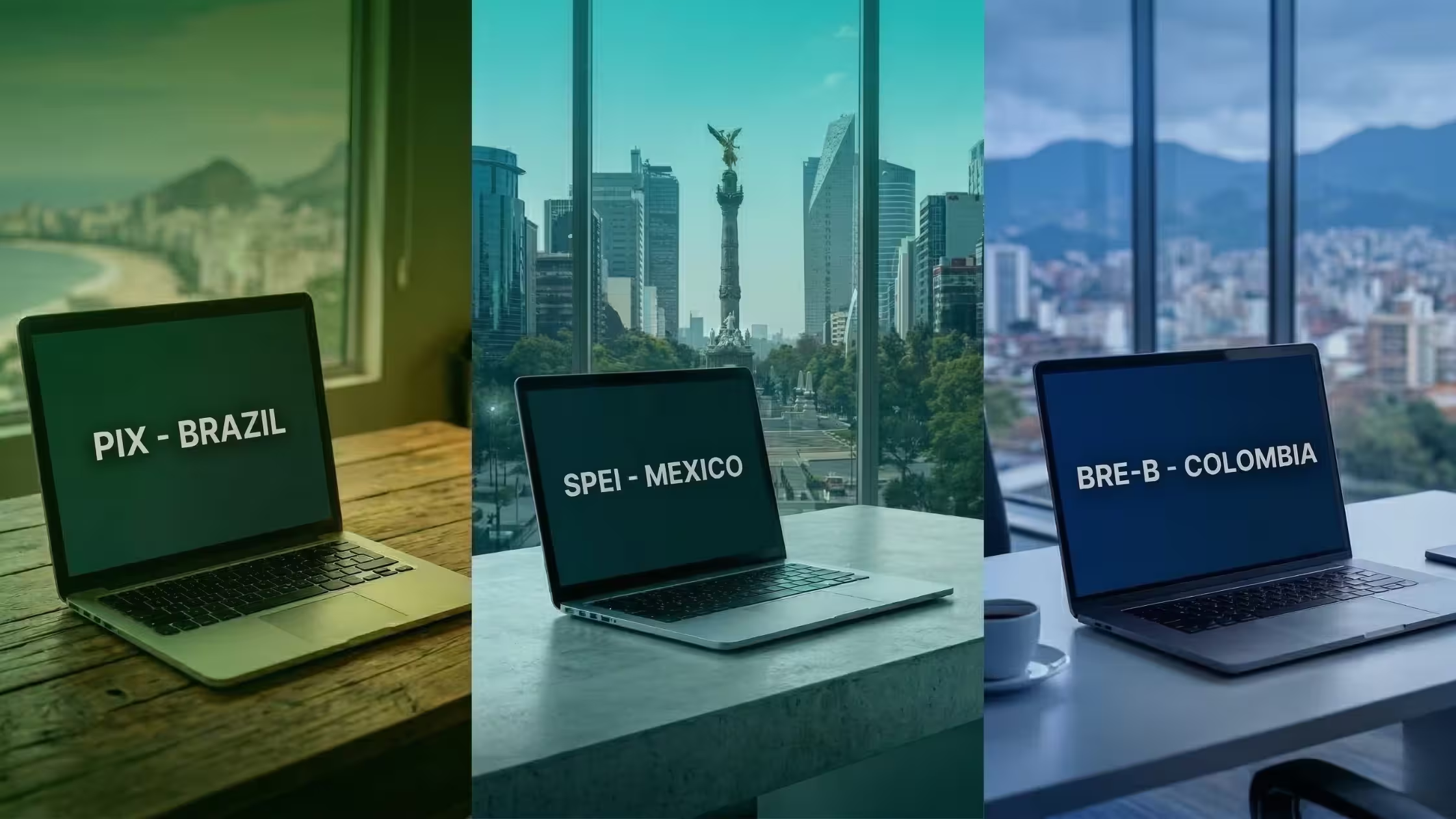
A common concern for CFOs is whether these emerging rails meet institutional security standards. The technical architecture behind modern rails in developing countries often exceeds legacy systems in the US due to "leapfrogging" technology.
Understanding the technical infrastructure behind payment rails helps identify integration requirements. While emerging systems prioritize speed, they still rely on core principles of clearing and settlement for a layered security approach:
Payment rails use three distinct settlement models, to ensure immediate finality and eliminate the settlement risk inherent in deferred batch systems:
In the context of payment rails, protocols for security and data protection aren’t just features, they are an integral part of the infrastructure as payment rails were developed to provide tranquility to both users and companies that their money is being moved in a safe and controlled way.
The layer of authentication and access control ensures that only authorized entities can initiate or approve a money movement.
For data protection, or encryption, there are mechanisms that keep the information from hackers in case they manage to intercept the data.
Modern money movement is defined by its metadata. The transition to ISO 20022 introduces structured XML-based formats that support extensive remittance information, reducing "lost data" errors common in older systems.
While this standardizes the language of payments, the dialects remain fragmented: enterprises must still contend with NACHA (U.S.), CNAB (Brazil), and varying proprietary APIs for instant rails like PIX or SPEI.
By utilizing a standardized abstraction layer, businesses can bypass the overhead of building custom integrations for every regional format, ensuring a seamless flow of data from initiation to settlement.
Managing multiple APIs, different regional standards (like CNAB in Brazil or NACHA in the US), and various settlement speeds can create immense operational overhead. The solution for modern enterprises is not to build these integrations manually, but to leverage a unified platform that allows:
Cobre’s Cross-Border Payments provides the infrastructure that allows businesses in Latin America and the US to operate across multiple rails through a single portal.
By integrating Cobre, your organization can leverage the most efficient payment rails in developing countries without the burden of managing disparate technical architectures.
Payment rails are the underlying digital infrastructure that allows money to move from a payer to a payee. Just as physical rails support a train, these systems support the flow of value.
The global landscape of moving money is undergoing a generational shift. For decades, the movement of capital relied on a complex web of correspondent banks and legacy messaging systems.
However, a new era of payment rails is emerging, characterized by instant finality, programmable compliance, and significantly lower operational costs.
Today, according to recent industry analysis, the US dollar and traditional systems are facing increased competition from alternative rails emerging from other countries, enhancing the role of other currencies within specific regions.
Alternative payment rails like blockchain technology, stablecoins, digital currencies and cross-boarder payment are reshaping global commerce with unprecedented speed and cost advantages.
What makes blockchain rails transformative it’s the ability to encode and automatically enforce payment rules at the ledger level.
Built on decentralized ledger technology, smart contracts automate complex payment logic, releasing funds when conditions are met without manual intervention.
Smart contracts are also utilized for atomic settlement: linking two assets to ensure that the transfer of one asset occurs if and only if the transfer of the other asset also occurs. This is often used in payment versus payment in a foreign exchange transaction.
Blockchain network transfers cost fractions of a penny while traditional wire transfers incur significant fees across multiple intermediaries, settle in minutes rather than days, and operate continuously without banking hours restrictions.
Enterprise blockchain has moved from experiment to production, with JPMorgan's Kinexys platform processing over US$2 billion to $7 billion on daily transactions.
The GENIUS Act (Guiding and Establishing National Innovation for U.S. Stablecoins) marked a turning point by establishing three pillars:
This allows companies to use stablecoins for immediate B2B payments such as USDC, settling global transactions at near-zero cost and eliminating the volatility risk that affected first-generation cryptocurrencies.
With over 130 countries currently exploring digital currencies, the shift toward programmable, government-backed money is built on three fundamental value propositions:
While the US remains a cornerstone of the financial world, some of the most significant innovations in real-time payments are happening in developing economies, particularly in Asia and Latin America.
The APAC region is currently winning the race for real-time payments. Countries like India (with UPI) and Singapore (with PayNow) have created ecosystems where instant transfers are the default, not the exception.
The regional push is now toward Project Nexus, a blueprint designed to connect these instant systems for 60-second international transfers across Asia.
Latin America has become a global benchmark for payment innovation. The region operates on a "multi-rail" approach where businesses combine traditional networks with high-velocity local systems:
A common concern for CFOs is whether these emerging rails meet institutional security standards. The technical architecture behind modern rails in developing countries often exceeds legacy systems in the US due to "leapfrogging" technology.
Understanding the technical infrastructure behind payment rails helps identify integration requirements. While emerging systems prioritize speed, they still rely on core principles of clearing and settlement for a layered security approach:
Payment rails use three distinct settlement models, to ensure immediate finality and eliminate the settlement risk inherent in deferred batch systems:
In the context of payment rails, protocols for security and data protection aren’t just features, they are an integral part of the infrastructure as payment rails were developed to provide tranquility to both users and companies that their money is being moved in a safe and controlled way.
The layer of authentication and access control ensures that only authorized entities can initiate or approve a money movement.
For data protection, or encryption, there are mechanisms that keep the information from hackers in case they manage to intercept the data.
Modern money movement is defined by its metadata. The transition to ISO 20022 introduces structured XML-based formats that support extensive remittance information, reducing "lost data" errors common in older systems.
While this standardizes the language of payments, the dialects remain fragmented: enterprises must still contend with NACHA (U.S.), CNAB (Brazil), and varying proprietary APIs for instant rails like PIX or SPEI.
By utilizing a standardized abstraction layer, businesses can bypass the overhead of building custom integrations for every regional format, ensuring a seamless flow of data from initiation to settlement.
Managing multiple APIs, different regional standards (like CNAB in Brazil or NACHA in the US), and various settlement speeds can create immense operational overhead. The solution for modern enterprises is not to build these integrations manually, but to leverage a unified platform that allows:
Cobre’s Cross-Border Payments provides the infrastructure that allows businesses in Latin America and the US to operate across multiple rails through a single portal.
By integrating Cobre, your organization can leverage the most efficient payment rails in developing countries without the burden of managing disparate technical architectures.