






Global Money Movement

Money Transfer Companies: How Does the Money Transfer Industry Work in Latin America?

Emilio Uribe
November 7, 2025
4 min de lectura
¿Qué es Cobre?
Somos la empresa lider de pagos empresariales inmediatos en Latinoamérica.
Conoce más
Comparte este artículo

The international remittance market in Latin America reached $161 billion in 2024, establishing itself as one of the region’s most lucrative financial industries.

While traditional money transfer giants like Western Union face unprecedented disruptions, new digital operators are capturing millions of customers with more agile offerings, and behind every money transfer lies a complex ecosystem of regulations, technology, and infrastructure that determines who can compete and how.

The remittance ecosystem: Understanding the business of moving money between countries

What are money transfer companies, and why do they matter?

Money transfer companies are financial institutions authorized to facilitate cross-border money transfers, connecting millions of migrants with their families.

In 2024, they processed $161 billion in remittances to Latin America, according to data from the World Bank and the Inter-American Development Bank, establishing themselves as one of the region’s most important sources of foreign exchange and a driver of economic development.

Their business involves collecting funds in the country of origin (primarily the United States, which accounts for 77% of the total sent to the region), converting currencies, and ensuring delivery to the final recipient.

This process involves complex regulations, sophisticated technology, and distribution networks ranging from commercial banks to institutions such as Mexico’s Banco del Bienestar, as well as neighborhood stores.

What sets them apart is their specialization in low-value but high-frequency personal transfers: between $131 and $648 USD per month on average.

The Evolution: From Traditional Agencies to Digital Operators

The remittance business has undergone a radical transformation over the past decade. Western Union and MoneyGram, which dominated the market for a century with networks of physical agents, now face competition from digital operators that promise instant and more affordable transfers.

The contrast is clear:

  • Traditional model: A combined network of 900,000 physical agents (Western Union and MoneyGram), total costs that can reach 5–10%, processing times ranging from hours to days depending on the delivery method.
  • Digital model: Primarily digital operation with cash pickup options where necessary, margins of 1–3%, processing times ranging from minutes to hours depending on the delivery method.

This evolution has democratized access. Remitly, Wise, and other fintechs have captured market share by offering a better user experience, transparency, and speed.

Technology has not only reduced costs; it has transformed consumer expectations about how an international money transfer should work.

El rol económico: Más allá de las transferencias familiares

In Honduras, El Salvador, Nicaragua, and Guatemala, family remittances account for between 20% and 28% of GDP, making them pillars of economic stability.

Their impact extends beyond household consumption: although 80% goes toward covering basic necessities and living expenses, the multiplier effect stimulates entire economies.

During crises such as the pandemic, remittances served as informal social security for recipient families.

However, this dependence creates vulnerability: changes in immigration policies or recessions in sending countries can have devastating effects.

Remittance companies are, therefore, critical actors in regional economic stability, not merely payment processors.

The $161 Billion Opportunity: An Analysis of the Latin American Market

Mexico: The Remittance Giant

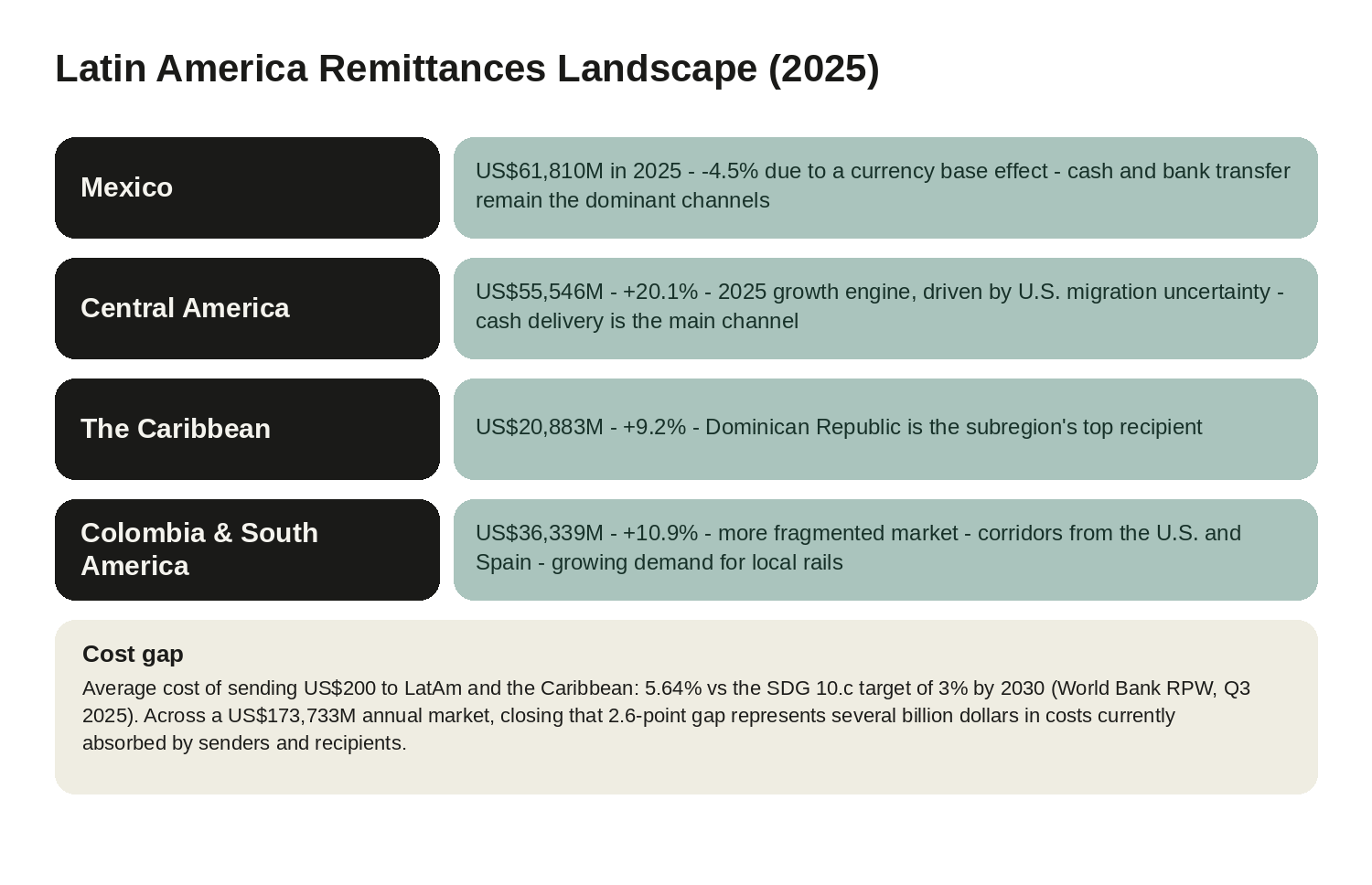
Mexico dominates the regional landscape with approximately US$65 billion annually, accounting for 40% of the Latin American total.

96% comes from the United States, where millions of Mexicans send an average of US$393 monthly directly to Mexico through various money transfer channels.

However, growth of just 2.3% marks the weakest expansion in a decade, reflecting the slowdown in Hispanic employment and the relative improvement of the Mexican economy.

Unlike Central America, where remittances exceed 25% of GDP, in Mexico they account for only 3.7%. This balance is ideal: a diversified economy that does not rely excessively on remittances, yet with $65 billion processed annually through the system.

This mature but not saturated market offers room for differentiated offerings beyond price.

Central America and the Caribbean: Remittance-dependent economies

Central America is the epicenter of structural dependence. Honduras leads the way with 27.3% of GDP, followed by Nicaragua (26.9%), El Salvador (24.3%), and Guatemala (19.5%).

These four countries receive $45.7 billion annually, sustaining entire economies through the labor of their migrants.

This dependency creates unique dynamics:

  • One-third of households depend directly on remittances
  • Any change in migration policies immediately impacts GDP

The Dominican Republic contributes an additional US$10.7 billion. For operators, these markets offer guaranteed demand but also social responsibility: they are critical national infrastructure.

South America is emerging as the most dynamic region. Colombia leads with US$11.83 billion in 2024, a 17.2% growth rate that doubles the regional average.

For the first time, Colombian remittances exceeded US$1 billion per month, benefiting 2.1 million recipients.

The region has distinctive characteristics: only 35.7% comes from the United States, Europe accounts for 36.2% (mainly Spain), and there is significant intraregional flow.

This diversification reduces risks and opens up non-traditional channels. Brazil (US$4.203 billion), Peru, and Ecuador round out a less saturated and more diversified market.

The Innovation Gap

The market faces a paradox: while volume grows, innovation stagnates.

According to the World Bank, the average cost of sending $200 USD to Latin America is 6.4%, while the Sustainable Development Goal (SDG 10.c) targets reducing this to 3% by 2030. In a market worth $165 billion USD annually, this efficiency gap represents billions in extra costs borne by families.

Friction points persist: processing times that take days when they could be minutes, excessive requirements such as multiple valid official identification documents, and limited access in rural areas.

Business Anatomy: How Modern Money Transfer Companies Operate

The Traditional Model: Western Union and the Agent Network

Western Union and MoneyGram built an empire based on physical presence: hundreds of thousands of locations, respectively, operating as a network of authorized agents.

Pharmacies, supermarkets, and stores act as service points, receiving a percentage of the commissions charged, while the parent company captures margins of 5–10% on the exchange rate, plus fees of $8–20 per transfer.

The traditional remittance mechanism solves the “last mile” problem: reaching unbanked populations where there is no internet. The recipient only needs identification and a code, with no need for a bank account.

Simple but costly: a transfer of $350 USD can lose $30 USD in fees and exchange rate spreads.

Digital Disruptors: Wise, Remitly, and the New Generation

Fintech companies have tackled traditional inefficiencies. Wise revolutionized the market with "mirror accounts": money never crosses borders.

If you send dollars to Mexico, Wise receives the funds in its U.S. bank account and pays out from its Mexican account, avoiding costly currency conversions.

This optimized electronic transfer system operates like a modern financial services provider.

The contrast is dramatic:

  • Fees: 0.5–2% vs. traditional variable fees plus exchange rate margins
  • Speed: minutes to hours vs. 24–72 hours
  • Exchange rate: mid-market rate with no markup vs. spreads of 3–6%
  • Onboarding: 5-minute digital process vs. in-person visits

Remitly reached $944 million in revenue in just 12 years by specializing in specific corridors and optimizing each route with dedicated technology for direct bank transfers.

Fintechs: When You’re a Money Transmitter Without Even Knowing It

Many tech companies discover too late that their operations qualify as money transmission.

Marketplaces paying international suppliers, freelance platforms facilitating cross-border payments, or wallets with cross-border P2P features can cross the regulatory threshold without intending to.

The legal reality is clear: moving money across jurisdictions without the proper licenses is not a “gray area”; it is regulatory non-compliance with severe consequences, including million-dollar fines, shutdown of operations, and personal liability for executives.

Digital wallets offering international services operate under two models: obtaining money transmitter licenses in each jurisdiction, or partnering with already-authorized money transmitters.

For example, in Mexico, some wallets facilitate remittances through partnerships with money transmitters registered with the CNBV, delegating the regulated operation to these specialized entities.

The message for founders is clear: if your product moves money across borders, you need a regulatory framework from day one.

The Hybrid Model: The Best of Both Worlds

The future is both digital and physical. MoneyGram is investing in technology while maintaining its agent network. Wise is signing local agreements for cash pickup. Superapps are integrating remittances alongside other services.

The hybrid model acknowledges diverse realities: digital for urban millennials with bank accounts, agents for rural areas without bank access, and both for comprehensive coverage.

Modern infrastructure can connect with traditional networks, accelerating payments while maintaining universal accessibility.

Companies that master this duality, combining instant bank transfers with cash options, will capture the market.

Regulatory Framework for Money Transmitters and Remittance Companies

Regulatory compliance sets the rules of the game for international remittances. Although frameworks vary by geography, the fundamental principles are consistent: transparency, traceability, and consumer protection.

United States: MSB, State Licensing, and the Multi-State Challenge

The United States operates under two simultaneous regulatory frameworks. At the federal level, all businesses must register as a Money Service Business (MSB) with FinCEN (Financial Crimes Enforcement Network) within the first 180 days, renewing every two years at no cost but with substantial obligations: a comprehensive AML (Anti-Money Laundering) program, SAR (Suspicious Activity Report) filings for suspicious activities, CTR (Currency Transaction Report) filings for cash transactions exceeding $10,000 USD (requiring additional documentation but with no limit on the amount), and the Travel Rule for transmitting sender/recipient information on transfers over $3,000.

The real challenge lies at the state level. Forty-nine states (all except Montana) require individual money transmitter licenses, each with unique requirements:

  • Surety bonds ranging from $25,000 to several million depending on the state and volume
  • Variable minimum capital, typically $500,000 USD or more
  • Application processes taking between 6 and 18 months
  • Total investment that can reach several million dollars

California, Texas, and Florida account for the largest volume of remittances to Latin America, making them priority markets.

Mexico: CNBV and the New Requirements for Money Transmitters

Mexico, which receives 40% of Latin American remittances—totaling $64.7 billion in 2024—requires the designation of Money Transmitter (MT), supervised by the CNBV (National Banking and Securities Commission). Requirements include:

  • Minimum capital of 500,000 UDIs (~$3.5 million USD)
  • Registration renewable every three years
  • Comprehensive anti-money laundering manuals
  • Identification of beneficial owners and documented organizational structure

99.1% of remittances are received electronically, with SPEI as the primary domestic settlement system, simplifying settlement but increasing the importance of reliable technological infrastructure, intensifying regulatory scrutiny, and reinforcing the need for robust AML (Anti-Money Laundering) / OFAC (Office of Foreign Assets Control) controls.

Colombia and the Region: A Mosaic of Local Regulations

Colombia operates under the Banco de la República’s foreign exchange regime through Foreign Exchange Market Intermediaries (IMC), entities authorized to channel international financial flows.

Modernization through Bre-B, the instant payment system, is creating opportunities for differentiation in speed.

The Latin American landscape is diverse: Guatemala processes $18 billion from the United States; in El Salvador, remittances account for 24% of GDP; Peru requires the designation of a Money Transfer Company (ETF). The common pattern: a local license or strategic alliance with an entity authorized for domestic settlement.

Universal compliance: AML/KYC as a non-negotiable foundation

Three pillars define compliance in any jurisdiction:

  • Robust AML program: documented policies, designated compliance officer, ongoing training, and independent audit
  • OFAC screening: real-time verification of senders, recipients, and counterparties against sanctions lists
  • Risk-based KYC: ranging from basic verification with official identification to enhanced due diligence for high-risk clients

The consequences of non-compliance with these financial regulations are severe: TD Bank faced $3 billion in penalties in 2024, and Binance faced $4.3 billion.

Infrastructures certified to ISO 27001, SOC 2, and PCI DSS demonstrate how technology can facilitate compliance while maintaining agile and secure operations.

The Three Models for Operating Remittance Services

The right model depends on available capital, timeline, and long-term vision.

Each option presents clear trade-offs between operational control, time to market, and initial investment. Most successful remittance companies start with one model and evolve as they validate the market.

Own Licenses: Total Control

This involves obtaining a federal MSB (Money Services Business) license, an MTL (Money Transmitter License) in key states (California, Texas, Florida), and registration as a Money Transmitter with the CNBV in Mexico.

  • Required investment: Significant, broken down as follows:
  • Licensing: State application fees (which vary widely), surety bonds (ranging from $25,000 to over $1 million per state), and legal compliance costs
  • Full technology stack: Development of payment infrastructure, banking integrations, compliance systems, and security systems
  • Regulatory capital: Includes the 500,000 UDIs (~$3.5M USD) required by the CNBV, plus capital reserves based on projected volume
  • Operations: Multidisciplinary team (legal, compliance, technology, operations) during the launch phase
  • Timeline: 12–18 months until the first transaction. State approvals take 6–12 months; the CNBV process adds another 6–12 months, run in parallel.
  • Trade-off: Full gross margin of 3.5–4% versus 2–2.5% in agency models. Complete control over product, data, and user experience. Significantly higher valuation for fundraising or exits..

Agency Model: Speed in Exchange for Margin

Operate as an authorized agent of a program manager with existing MTL licenses. Typical structure: the agent typically retains 30–40% of revenue.

  • Required investment: $1–2.5 million USD for basic compliance ($90,000–200,000 USD), front-end development ($225,000–550,000 USD), minimal working capital ($250,000–500,000 USD), and a team of 8–12 people.
  • Timeline: 60–90 days until first transaction. Investment 60–67% lower than the in-house model.
  • Critical trade-off: Despite operational delegation, the remittance company retains 100% legal responsibility for BSA (Bank Secrecy Act)/AML and OFAC compliance before regulators. Reliance on the program manager for SLAs and product changes.

Infrastructure as a Service: The Hybrid Model

Combines proprietary MTL licenses in priority states while leveraging specialized payment infrastructure for cross-border settlement.

The remittance company retains control of the front-end and compliance, while using specialized platforms to facilitate payouts via SPEI and Bre-B, 24/7, and manage same-day settlement.

  • Required investment: $1–2 million optimized for state licensing, front-end development with APIs, and a dedicated team of 8–10 people.
  • Timeline: 60–90 days to an operational MVP while state licenses are processed in parallel.
  • Observed economics: Significantly faster time-to-market than proprietary infrastructure, with approximately 60–70% less initial capital. Net margin 10–15 percentage points higher than the pure agency model. Multi-broker scalability via a single API without building infrastructure country by country.

The right choice depends on three variables: access to seed capital, the urgency of time-to-revenue, and where your unique competitive advantage lies.

The required infrastructure

Payment infrastructure determines whether a remittance arrives in seconds or days, whether a transaction scales or fails, and whether margins allow you to compete.

Beyond licensing, the technological architecture defines a remittance company’s commercial viability.

Payment rails

Payment rails are the highways along which money travels between countries. Every international payment order passes through these systems, and choosing the right ones makes the difference between competing and falling behind.

In Mexico, SPEI processed 5.4 billion transactions in 2024, with 30% annual growth. This system has established itself as the backbone of the ecosystem:

  • Continuous operation: 24/7/365 with no maintenance windows
  • Immediate settlement: Funds in real time, not days later
  • Mass adoption: Six out of ten Mexicans use SPEI; 99% of remittances are processed electronically
  • Full interoperability: Connects all financial institutions

Colombia launched Bre-B in October 2025, with 227 participating institutions and more than 31 million registered users.

Connecting directly to these systems rather than relying on intermediaries can result in savings of several percentage points in operating costs.

Settlement

Settlement is the final process where funds are actually transferred and transactions are completed; it is where financial strategy meets operational reality.

In practical terms, settlement answers the question: when and how do funds actually reach the beneficiary’s account in the destination country?

Money transfer companies face a fundamental dilemma: speed versus capital efficiency.

“Prefunding” places capital in bank accounts in the destination country before transactions arrive, allowing for settlement in seconds but tying up millions in each market.

“Daily net settlement” optimizes capital usage by processing all transactions of the day in a single batch, but introduces cut-off windows that can cause delays of up to 24 hours for the beneficiary.

The “hybrid model” balances both approaches: it pre-funds urgent transactions up to a certain threshold and optimizes delivery times based on the volume and profile of each corridor.

Underpinning any strategy are real-time reconciliation systems and the ability to dynamically rebalance capital across markets based on demand

Last-mile delivery

The last mile defines the beneficiary’s experience and the unit economics.

In Mexico, direct deposits via SPEI dominate, but cash pickup remains essential in rural areas. In Colombia, Bre-B opens up possibilities for instant P2P and P2B transfers.

Each method has its own economics and directly affects the total cost to the end user:

  • Direct deposit: Lower cost, better UX, requires access to banking services
  • Digital wallets: Instant speed, growing adoption
  • Cash pickup: Higher cost, complex logistics, essential for financial inclusion

Transaction costs vary significantly depending on the chosen method, so the distribution strategy must balance coverage with profitability.

APIs vs. in-house development

The fundamental decision: build proprietary infrastructure or integrate with existing platforms.

In-house development requires 12–18 months and potentially hundreds of thousands of dollars, in addition to specialized expertise in banking integration, compliance, and multiple payment channels.

The alternative is to leverage proven infrastructure from expert companies.

This approach allows you to focus on competitive differentiation, user experience, customer acquisition, and pricing while specialists handle the complexity.

Operational Challenges for Money Transfer Companies in Latin America

Launching a money transfer company is just the beginning. In 2024, fraud losses reached $12.5 billion in the United States (a 25% year-over-year increase), while 73% of users in Mexico abandon fintech apps within their first week. Operational challenges determine which companies scale up and which disappear.

Multi-currency liquidity and treasury management

Companies must balance sufficient pre-funding for competitive speed, controlled foreign exchange exposure to protect margins, and accurate reconciliation across multiple banks and countries.

Mexico requires peso balances for immediate SPEI, Colombia needs local liquidity for Bre-B, while Central America demands cash pre-funding with partners.

Without centralized visibility, you end up with idle capital in one market and a shortage in another.

The most common challenges:

  • Manual reconciliation across 5–10 bank accounts consumes 40+ hours per month
  • Unhedged FX exposure erodes margins by up to 2–3 percentage points
  • Reconciliation errors impact financial reporting and compliance

For remittance companies operating multiple corridors simultaneously, this consolidated visibility is the difference between informed and reactive capital decisions.

Fraud and Risk

79% of organizations experienced payment fraud in 2024. Money transfer companies are attractive targets due to their high transaction volumes and cross-border nature.

The main attack vectors include account takeover, muling and smurfing, first-party fraud via chargebacks, and Business Email Compromise.

By 2025, 90% of financial institutions will implement AI for fraud detection. Manual controls cannot scale with thousands of daily transactions.

An effective anti-fraud program requires:

  • Real-time monitoring with machine learning for anomalous patterns.
  • Automated OFAC screening with false positives <0.05%
  • Dynamic limits that scale based on user behavior
  • Device intelligence and geolocation for suspicious activity

ISO 27001, SOC 2, and PCI DSS certifications demonstrate operational maturity in a market where security reputation is a critical business asset.

Companies that build on already certified infrastructure, such as that offered by Cobre, can accelerate their go-to-market while maintaining institutional standards from day one.

International Scaling

Each country involves local licenses, different payment rails, specific regulations, and unique languages. Building infrastructure from scratch takes 12–18 months per market, with setup costs ranging from $200,000 to $800,000, not including regulatory capital.

Money transfer companies that scale quickly strike a balance between control (where it creates a competitive advantage) and leveraging existing infrastructure.

Leveraging platforms with direct connectivity to SPEI in Mexico, Bre-B in Colombia, and regional rails significantly accelerates time-to-market.

Customer Retention in a Commodity Market

The churn rate in fintech hovers between 5–10% monthly, with an annual retention rate of just 37%. Acquiring a new customer costs between 5 and 25 times more than retaining an existing one. If monthly churn exceeds growth, companies invest aggressively just to maintain their current customer base.

Retention is built on three pillars: seamless onboarding with registration taking less than 5 minutes, a consistent experience with accurate ETAs and transparent tracking, and genuine personalization that distinguishes personal transfers from commercial payments.

71% of consumers expect personalized content, and companies that prioritize it can generate significantly higher revenue—up to 40% more.

In a commodity market, differentiation comes from turning transactions into valuable relationships.

In summary...

The Latin American remittance market represents $161 billion annually in critical infrastructure that supports entire economies.

The remittance companies that scale aren’t the ones building everything from scratch, but rather those that identify where their real competitive advantage lies and delegate the complexity of infrastructure to specialists.

With SPEI processing 5.4 billion transactions annually and the launch of instant payment systems in Colombia, modern rails exist throughout the region; the question isn’t technological—it’s strategic.

At Cobre, we build the infrastructure on which the fintechs of the future operate, precisely because we understand that moving money between countries is not the end product: it is the foundation for building financial products and services that transform lives.

The time to redefine how Latin America moves money is now.

Frequently Asked Questions

What is a money transfer company?

A money transfer company (or remittance company) is a firm that facilitates the sending of money between countries, typically from migrant workers to their families. In the U.S., it requires a Money Transmitter license, while in Mexico it operates as a Money Transmitter registered with the CNBV. Companies like Western Union or Wise are money transfer companies.

What is an example of a remittance transfer?

A Mexican worker in the United States sends $350 to his family in Guadalajara using a remittance app. The money is converted to pesos and reaches the recipient’s bank account within minutes via SPEI. The family receives approximately $6,000 pesos, after deducting the fee and applying the exchange rate.

What is a remittance?

A remittance is a money transfer that a person sends from abroad, typically to family members in their home country. In 2024, Mexico received $64.7 billion in remittances, with 99% processed electronically. Remittances cover basic needs such as food, healthcare, and education for millions of Latin American families.

What are money transmitters?

Money transmitters are companies authorized to receive and send funds between individuals. In Mexico, they are regulated by the National Banking and Securities Commission (CNBV) under the General Law on Credit Auxiliary Organizations and Activities (LGOAAC) and require a minimum capital of 500,000 UDIs (~$3.5 million USD). They must renew their registration every 3 years and comply with strict anti-money laundering (AML/CFT) regulations to operate legally.

Who regulates money transmitters?

In the United States: FinCEN at the federal level (MSB registration) and each individual state (MTL licenses). In Mexico: the CNBV supervises money transmitters, and the UIF monitors anti-money laundering compliance. In Colombia: The Banco de la República regulates them as Foreign Exchange Market Intermediaries (IMC). Each Latin American country has its own financial supervisory authority.

Is PayPal a money transmitter?

Yes. PayPal operates as a money transmitter in the U.S. with state licenses and MSB registration with FinCEN. Its Xoom service, focused on international remittances, also requires compliance with the Consumer Financial Protection Bureau’s (CFPB) Remittance Rule. PayPal holds licenses in 49 states and complies with AML/KYC regulations in every jurisdiction where it operates.

How many money transmitters are there in Mexico?

The National Banking and Securities Commission (CNBV) maintains an updated public registry of authorized money transmitters in Mexico. As of 2025, dozens of registered companies are operating, ranging from large international operators like MoneyGram to local fintechs. The number fluctuates constantly due to new authorizations and renewals. Check the official registry on the CNBV website.

Escrito por:
Emilio Uribe
Chief of Product & Operations

Hablemos sobre cómo optimizar tus pagos

Completa el formulario y te contactaremos en menos de 24 horas hábiles
+3x
más rápido el procesamiento de pagos.
-56%
de errores transaccionales con las APIs de Cobre.
-50h
mensuales dedicadas a conciliación, ahora automatizadas.
+3x
más rápido el procesamiento de pagos.
-56%
-56%
-50h
mensuales dedicadas a conciliación, ahora automatizadas.
Optimiza tus procesos financieros con Cobre
Centraliza tu operación local e internacional en una sola plataforma.
Contacta a ventas