













Direct Debit: Optimize Your Business Collections
According to TransUnion’s latest Credit Industry Report, credit origination in Colombia grew across all product categories toward the end of 2025.
For businesses with recurring revenue, more customers with active obligations means a higher volume of collections to manage—a process that many still handle manually, with all the friction and operational burden that entails.
Direct debit transforms this dynamic: it automates collections, reduces repetitive tasks, and strengthens your financial relationship with your customers. In this guide, we explore what it is, how it works, and how to implement it.
What is direct debit and how does it work in Colombia?
In practical terms, direct debit (or automatic payment) allows your company to collect payments directly from your customers’ accounts, regardless of whether they are with banks other than your own.
Colombia has a robust infrastructure that allows companies to collect payments directly from their customers’ accounts, even when those accounts are held at different banks.
Three key players are involved in this system:
- Originating Financial Institution (EFO): the bank of the company collecting the payment
- Receiving Financial Institution (EFR): the bank of the paying customer
- ACH Operator: facilitates the exchange of information between both institutions
A fundamental principle: the debit can only be executed with the account holder’s prior authorization.
The Step-by-Step Technical Process
While the details may vary depending on the financial institution you work with, broadly speaking, the process follows this flow:
- The company generates a file containing the debit instructions
- It sends it to its bank via the business portal
- The ACH operator processes the transaction between institutions
- The customer’s account is debited
- The funds are credited to the collecting company
Before each debit, the system sends a pre-notification to verify that the account number matches the account holder’s identification. If the debit fails due to insufficient funds, it is generally possible to schedule retries for the following days.
Payment infrastructure: CENIT and ACH Colombia
The interoperability of automatic debits in Colombia is made possible by two systems that connect the country’s financial institutions:
- CENIT (National Interbank Electronic Clearing): This is the ACH (Automated Clearing House) operated by the Central Bank of Colombia. It processes low-value electronic payment and collection orders, including pre-notified debits that validate account information before the payment is processed.
- ACH Colombia: This is the private network connecting the country’s commercial banks. It processes interbank transfers, payments, and automatic debits among affiliated institutions.
Thanks to this infrastructure, a company can collect payments via automatic debit from customers who have accounts at virtually any bank in the Colombian financial system.
Types of automatic debit available to businesses
Not all billing models are the same, and choosing the right payment method depends on how your business collects payments.
There are options designed for fixed amounts, others for variable billing, and alternatives that operate with cards instead of bank accounts.
Pre-authorized collection: ideal for fixed amounts
In this method, the amount to be debited is the same in each period. It can be defined by the collecting company or by the payer at the time of authorization.
It is ideal for businesses with predictable charges and subscription management:
- Gym memberships
- SaaS subscriptions with fixed plans
- Credit installments with a constant value
- Schools with fixed tuition
- Condominium associations
Its main advantage is operational simplicity: once set up, it does not require updating amounts each billing period. However, if the service fee changes, the authorization must be updated or you must switch to on-demand collection.
On-demand collection + ACH: for variable billing
Here, the amount varies based on each billing period’s charges, defined by the collection company according to the customer’s consumption or usage. The company sends debit orders with specific amounts through the business portal before each billing cycle.
It is the natural choice for monthly bills with variable amounts:
- Utilities (water, electricity, gas)
- Telecommunications
- Billing based on metered consumption
- Professional services with variable fees
- On-demand transportation service platforms
The advantage: flexibility to adjust the charge based on the actual bill without modifying authorizations.
Credit and debit card debits
This method tokenizes card data on a payment gateway, enabling recurring automatic payments without the customer having to enter information each time.
Unlike bank account debits, it does not operate through ACH but rather through card networks such as Visa or Mastercard, which requires integration with a payment gateway.
Among its advantages:
- Automatic retries for failed collections
- Greater reach among customers who prefer not to share banking information
- Ability to reach customers without a bank account but with a card
The main consideration is fees, which are typically higher than for ACH debits.
Advantages of automatic debit for cash management
Beyond operational convenience, automatic debit has a direct impact on key financial indicators. Its benefits extend from cash flow to customer relationships, transforming how your company manages its collection cycle.
Impact on cash flow and reduction of delinquent accounts
By scheduling collections on specific dates, you can more accurately forecast your monthly revenue. The collection is executed automatically on the agreed-upon date, eliminating the reliance on the customer “remembering” to pay.
This translates to:
- A reduction in delinquent accounts due to forgetfulness or delays.
- Acceleration of the collection cycle by eliminating waiting days between invoicing and payment.
- Faster availability of funds, without the delays associated with cashing checks or manual transfers.
The impact on liquidity is amplified when direct debit operates on an instant payment network.
With the launch of Bre-B, Colombia’s instant payment system, businesses can receive funds in seconds, even outside traditional banking hours. Platforms like Cobre already allow businesses to collect payments through this system, combining direct debit automation with the immediacy of the new network.
Operational Efficiency and Cost Reduction
Automating collections frees your finance team from repetitive tasks: reminder calls, tracking outstanding payments, and manually recording transactions. That time can be dedicated to activities of greater strategic value.
Other operational benefits include:
- Elimination of cash handling and its associated security and logistics costs
- Reduced errors in payment recording and reconciliation
- Centralized information that facilitates month-end closing
For companies that operate with multiple banks, the additional challenge is consolidating collection information in a single place.
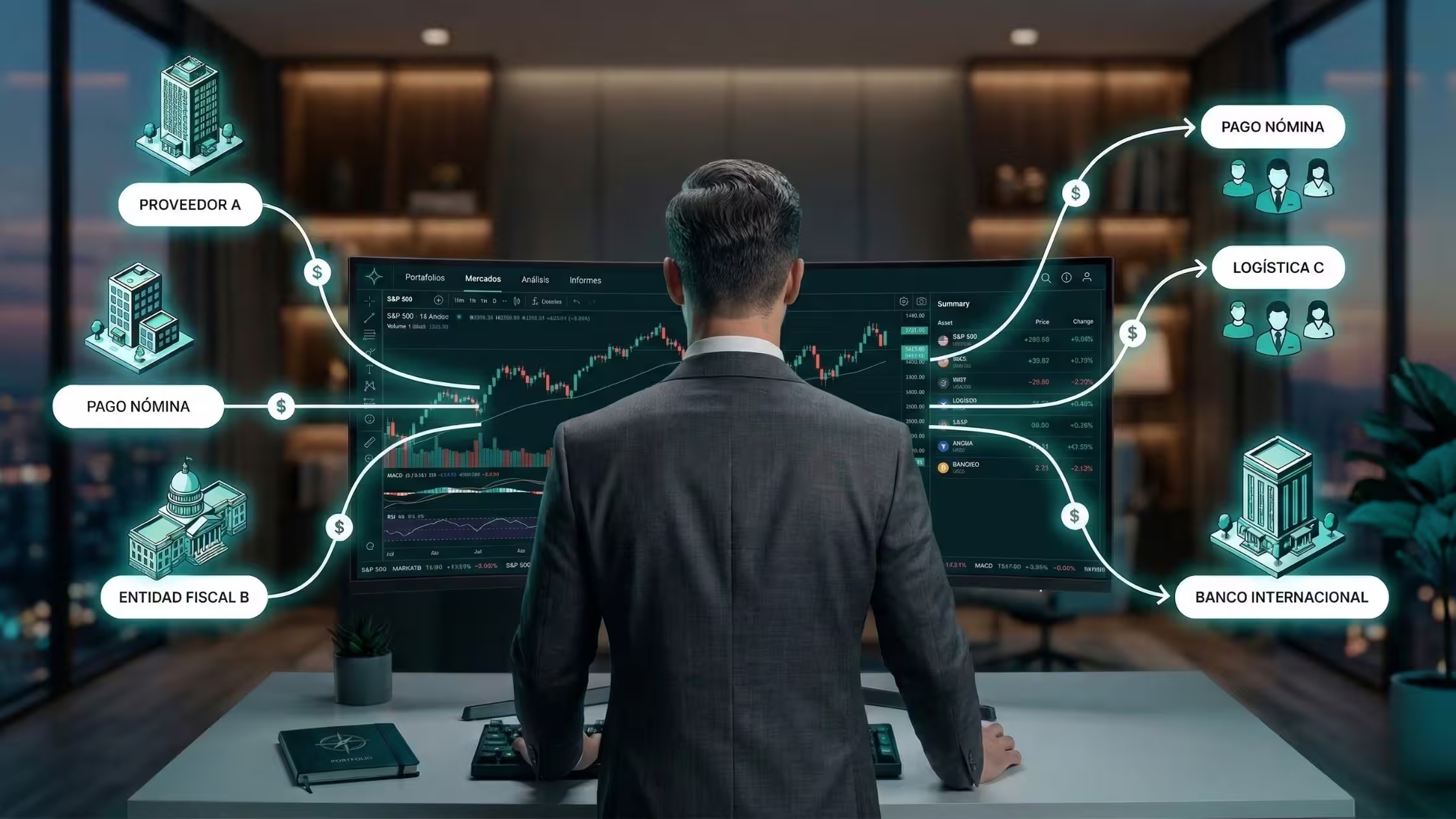
Treasury centralization solutions, such as Cobre Connect, allow you to view all bank accounts in a single portal, check transactions in real time, and generate reports without relying on scattered spreadsheets.
Improved Customer Experience and Loyalty
For your customers, automatic debit means convenience: they don’t need to remember dates, stand in line, or log in to websites every month. The payment simply happens.
However, it is essential that the customer explicitly authorizes this payment method. True loyalty is only achieved when the customer actively chooses automatic debit and understands how it works.
Without this clear authorization, automatic charges can have the opposite effect: rejection, complaints about unrecognized charges, and a loss of trust in your company. Transparency in the sign-up process is key to avoiding disputes and chargebacks.
This reduces involuntary delinquencies—those that occur due to forgetfulness rather than an inability to pay. Additionally, customers enrolled in automatic debit tend to stay longer, since switching to another provider requires reconfiguring their payments.
Some financial institutions allow you to set up a cascading payment: if there are insufficient funds in the savings account, the system tries the checking account, and then the credit card.
This configuration, available through certain banks, increases the collection success rate without manual intervention.
Common Challenges and How to Overcome Them
Implementing automatic debit isn’t without its hurdles. Anticipating these challenges and having clear strategies to address them is key to maximizing the success rate of your collection program.
1. Obtaining Customer Authorizations
Some customers are reluctant to grant payment authorization allowing direct debits from their bank account, whether due to mistrust or lack of awareness.
To overcome this, clearly communicate the benefits: no more late payments, no lines, and no dates to remember.
Offering incentives such as sign-up discounts and simplifying the process—ideally digitally—helps reduce friction.
2. Insufficient funds in the customer’s account
The debit fails when the account lacks sufficient funds, resulting in declined transactions and extra work.
The solution is to schedule automatic payments with retries on subsequent days and send advance notifications to the customer reminding them of the payment date.
Some banks allow you to set up cascading payments across the customer’s various accounts.
3. Managing Multiple Banking Portals
Working with multiple banks involves managing different platforms, interfaces, and formats, which increases the operational burden.
Evaluate treasury centralization solutions or a payment processor that consolidates operations into a single dashboard and standardizes processes.
4. Updating account information
Customers switch banks or close accounts without notifying you, causing systematic payment rejections.
Implement periodic data validation campaigns, monitor rejection rates to identify patterns, and provide channels for customers to report changes.
5. Claims and Reversals
Consumers can reverse automatic payments or revoke authorizations at any time, according to Colombian regulations.
As a collection agency or service provider, keep authorizations properly documented with clear terms of authorization, respond promptly to claims, and establish processes to manage reversals without affecting the business relationship.
Payment automation brings enormous benefits, but requires preparation for these scenarios.
Direct Debit vs. Other Collection Methods: Which One Should You Choose?
Direct debit isn’t the only option for collecting payments, and choosing the right method depends on your business model, the type of customer, and the frequency of billing.
- Direct Debit: The company processes the payment directly. It requires prior signed authorization. It is ideal for predictable recurring payments, long-term relationships, and periodic billing. Its main advantage is full automation: once enrolled, the automatic payment is processed in each cycle without the customer having to do anything. It requires authorization management and an onboarding process.
- Checkout: The customer actively processes the payment on a checkout page. It does not require prior authorization. It works well for one-time payments, e-commerce purchases, and new customers without an established relationship. It offers 24/7 availability and broad bank coverage through PSE, Botón Bancolombia, and others. Consideration: it depends on the customer’s action, so it does not guarantee collection on a specific date.
- Payment links: The company sends the payment link, and the customer completes the payment. No prerequisites. Ideal for one-time collections, reminders, occasional customers, or sales via WhatsApp and social media. Its advantage is flexibility: the customer chooses the payment method. It also depends on the customer’s action.
- Traditional transfers: The customer makes the transfer manually using the recipient’s account details. This works for high-value B2B payments, payments to service providers, and one-time transactions. Fixed fees rather than percentage-based fees, which is more cost-effective for large amounts. It is entirely manual and requires subsequent reconciliation..
Which one to choose? For businesses with recurring revenue and long-term relationships, automatic debit is the most efficient option: it maximizes the collection rate and minimizes the operational burden.
For one-time sales, new customers, or occasional transactions, PSE or payment links offer greater flexibility.
The optimal strategy usually combines several methods depending on the customer segment.
How can you optimize your collections?
Direct debit transforms the way businesses manage their collections. By processing automatic payments on each due date, you eliminate the need for your customers to remember to pay and significantly reduce the operational burden on your finance team.
Whether for recurring service payments, subscriptions, or periodic billing, implementing a system that collects payments automatically improves your cash flow, reduces delinquent accounts, and strengthens your relationship with customers by offering them a frictionless experience.
The key lies in choosing the right infrastructure, properly managing authorizations, and complementing this with other collection methods based on each segment’s profile.
Ready to optimize your business collections? Learn how Cobre can help you automate your collections and centralize your financial operations on a single platform.