




How the stablecoin sandwich transforms B2B international payments
Stablecoin sandwich is the architecture that optimizes liquidity for enterprises requiring an operational layer that combines the immediacy of modern digital networks with the reliability of local banking infrastructure.
Key takeaways
- Legacy cross-border banking networks cause costly corporate treasury bottlenecks.
- A stablecoin sandwich wraps digital transit between fiat conversions.
- Stablecoin for executing international B2B transactions in minutes.
- Automated, rapid execution eliminates corporate digital asset volatility exposure.
- Ultimately, unified dashboards automate multi-currency ledger reconciliation.
Modern corporate treasuries face a persistent bottleneck. While domestic retail payments have evolved toward instant, real-time settlement architectures, international B2B transactions remain tethered to outdated correspondent banking frameworks.
For Chief Financial Officers (CFOs), Chief Technology Officers (CTOs), and Treasury Directors managing multi-million dollar capital flows for multinational operations, marketplaces, or vendor networks, this lag is more than an inconvenience—it represents locked working capital, hidden foreign exchange fees, and administrative friction.
As global cross-border payments expand, traditional infrastructures struggle to scale efficiently. Moving money internationally via traditional wire methods generally incurs settlement windows of two to five business days, transaction fees averaging between 1.5% and 2.9%, and structural capital traps like mandatory funding of Nostro/Vostro accounts.
The architecture of the stablecoin sandwich
A stablecoin sandwich is a B2B cross-border payment architecture that wraps an efficient digital network transfer between two traditional fiat currency conversions.
Under this framework, fiat-backed stablecoins are utilized strictly as high-speed transit vehicles rather than long-term asset reserves.
The model relies on an integrated execution pipeline divided into three distinct phases:
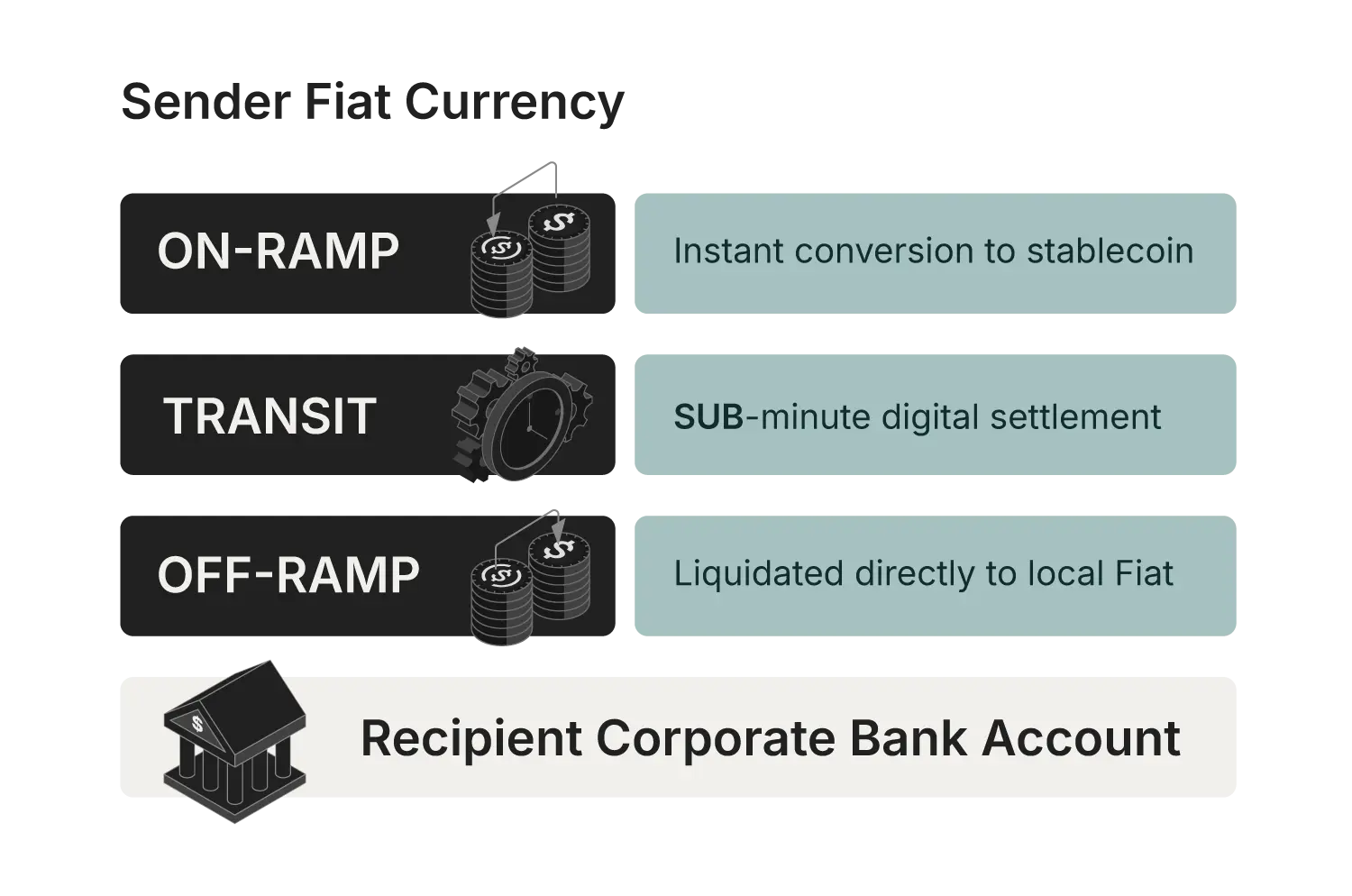
1. The On-Ramp Phase (First Slice of Bread)
The initiating corporation funds the transaction in its local fiat currency using standard domestic payment rails like SPEI or integrated platform services.
A specialized payment orchestration layer or fintech infrastructure provider ingests the funds and automatically mints or purchases an equivalent volume of a fiat-backed stablecoin, such as USDC or a compliant regional token.
2. The Conversion And Transit Phase (The Meat)
The digital asset moves across high-throughput, institutional-grade decentralized infrastructure. Rather than passing through multiple correspondent banks that add sequential markups and operational delays, the transaction executes as a direct token routing mechanism.
Settlement across these digital balance networks takes less than a minute, effectively bypassing standard banking hours, geographic boundaries, and capital control windows.
3. The Off-Ramp Phase (Second Slice Of Bread)
Upon reaching the destination jurisdiction, the infrastructure provider’s local payout partner receives the token and immediately liquidates it back into the recipient's domestic fiat currency.
The funds are then disbursed through local real-time payment rails directly into the beneficiary’s traditional corporate bank account.
For corporate end-users, the underlying digital token architecture remains completely abstracted.
The transaction functions seamlessly as a fiat-to-fiat commercial exchange, combining the execution speed of digital payment networks with the familiarity of local banking endpoints.
Mitigating Risk for CFOs: Security and Volatility Control
Corporate treasurers naturally exercise caution regarding digital asset exposure. Primary institutional concerns generally focus on asset volatility, the risk of a token "de-peg" (losing its 1:1 parity with the underlying fiat currency), and stringent regulatory compliance.
The stablecoin sandwich architecture inherently mitigates these liabilities.
Eliminating Market Volatility Exposure
In a standard digital asset transaction, holding tokens on a balance sheet exposes an enterprise to price fluctuations. The sandwich model eliminates this exposure through automated, consecutive execution.
Because the token is acquired, routed, and liquidated within a compressed timeframe, the holding window lasts only minutes or seconds.
This structural design minimizes market risk, protecting the corporate treasury from exchange rate shifts during transit.
Institutional-Grade Asset Security
To maintain absolute stability, the architecture utilizes fully audited, fiat-backed tokens backed by high-quality, liquid reserves.
Regulatory standards for stablecoins backed by fiat currency dictate clear structural parameters:
- Fiat-Backed Security: Leading institutional tokens maintain strict 1:1 reserves composed exclusively of cash and short-term government instruments, such as U.S. Treasury bills.
- The Global Regulatory Shift: Compliance frameworks provide robust oversight. In Europe, the MiCA (Markets in Crypto-Assets) regulation sets the standard for electronic money tokens, mandating continuous redemption rights and audited asset isolation. In the United States, legislative frameworks ensure structural transparency and prioritize token holder safety in insolvency scenarios. Regionally, frameworks like Mexico's Ley Fintech require structured operational oversight, while Colombia's specialized regulatory sandboxes ensure compliant cross-border asset routing.
Embedded Compliance Infrastructure
Enterprise-grade orchestration platforms embed automated compliance checks into the core transactional flow.
Before any fiat-to-token or token-to-fiat conversion occurs, the system runs programmatic Know Your Customer (KYC) and Know Your Business (KYB) checks, screens against global sanction lists (such as OFAC), and performs real-time anti-money laundering (AML) monitoring.
This automated compliance framework allows multinational treasuries to scale international disbursements while maintaining institutional standards, including SOC 2 Type II and ISO 27001 data verifications.
Use cases of stablecoin sandwich for enterprises with international transactions
The stablecoin sandwich provides practical utility across major corporate finance, marketplace orchestration, and supply chain management contexts.
Supply Chain and Global Vendor Management
Multinational manufacturing and retail operations frequently manage complex cross-border supply chains.
Relying on traditional bank wires often forces treasurers to dispatch payments up to five days in advance to ensure on-time delivery, trapping essential working capital in transit.
By deploying a stablecoin sandwich architecture, corporations can initiate regional currency payouts on the exact date cargo is dispatched. Funds settle into the supplier's local bank account within minutes, optimizing liquidity and freeing up capital that would otherwise remain idle in transit.
Centralized Multi-Country Liquidity Management
Global enterprises with regional subsidiaries often face fragmented liquidity pooling. Maintaining multiple local bank balances across volatile regions exposes corporate capital to inflationary devaluation and high local maintenance costs.
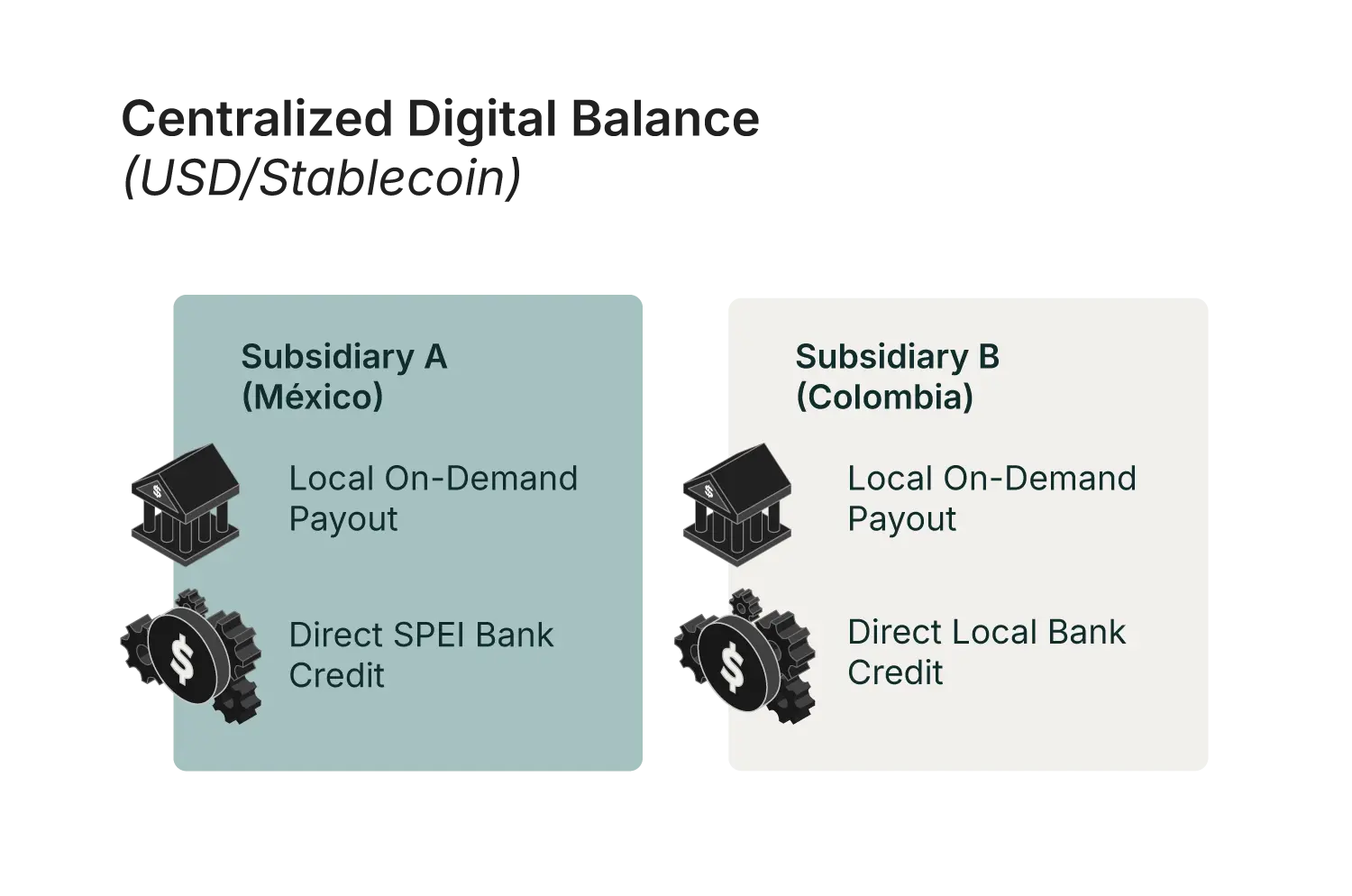
The sandwich model allows organizations to centralize operational capital into unified treasury balances.
Instead of pre-funding separate regional bank accounts, companies can hold core operational funds in a secure currency position.
When a subsidiary requires an operational disbursement—such as a localized payroll run or vendor settlement—the centralized platform triggers an automated sandwich transaction, routing liquidity down to local payment networks on demand.
This is cross-border payments for enterprises made frictionless.
Enterprise Data Orchestration And Accounting Reconciliation
Immediate execution is only effective if accounting records sync at the same speed. A significant limitation of legacy cross-border wires is the manual reconciliation work required to match incoming bank statements with open ERP entries.
Modern payment solutions address this data gap by pairing transaction velocity with high-throughput reporting tools:
Automated Ledger Syncing Via Webhooks
Enterprise routing platforms run on asynchronous data architectures. As soon as a transaction executes on-chain and lands in the recipient’s local banking rail, the platform triggers automated webhooks.
These programmatic alerts feed transaction data directly into the corporation's internal ERP system (such as SAP or Oracle), facilitating automated ledger updates without manual intervention.
Unified Multi-Network Balance Visibility
Rather than auditing various fragmented banking interfaces across multiple jurisdictions, corporate finance teams can leverage a unified master ledger.
System architectures compile transactions across various underlying networks into a standard, structured dashboard.
This approach translates complex asset routing data into a clear operational view, giving international cash movements the same transparency as local domestic bank transfers.
Structured Metadata and Mass Payment Distribution
When executing high-volume payouts the underlying system bundles transactions into coordinated batches.
Every execution generates structured financial data files (available in standard CSV, JSON, and PDF formats) enriched with internal metadata.
This tracking includes custom billing tokens, explicit counterparty information, and clear transaction identifiers, allowing corporate compliance and accounting departments to track individual disbursements even within massive payment batches.
Modernizing Your International Payment Operations
The global corporate treasury landscape is shifting away from fragmented, multi-day banking networks toward real-time, programmatic cash coordination.
The stablecoin sandwich architecture delivers a functional and secure alternative, providing the settlement speed of advanced digital balance networks alongside the structural safety of established domestic banking rails.
Is your company ready to optimize its cross-border cash flows?
Discover how Cobre can simplify your business’ payment orchestration with stablecoin support. Our platform will enable seamless automation of your cross-border cash management strategy from a unified dashboard, operating 24/7/365 with localized endpoints.
Frequently Asked Questions about Stablecoin Sandwich
What Is A "Stablecoin Sandwich" And How Does It Work?
A stablecoin sandwich is a B2B cross-border payment architecture that wraps a high-speed digital token transfer between two traditional fiat currency conversions using crypto ramps. Read more about on-ramp and off ramp on our dedicated article.
How Does This Architecture Eliminate Digital Asset Volatility For Corporate Treasuries?
Holding cryptocurrency on a balance sheet normally exposes a company to unpredictable market fluctuations. The sandwich model eliminates this risk through automated, consecutive execution.
Because the on-ramp, token transit, and off-ramp occur within a compressed timeframe, the entire transaction settles in seconds or minutes.
The enterprise holds the digital asset for a microscopic window, protecting the corporate treasury from exchange rate shifts.
Do enterprises need to manage crypto wallets or alter their accounting systems to use it?
No. For the corporate end-user, the underlying digital token architecture is completely abstracted. The transaction functions seamlessly as a traditional fiat-to-fiat commercial exchange.
On the accounting side, modern orchestration platforms pair this execution speed with developer-first APIs and Webhooks. As soon as a transaction settles, the platform triggers an automated update that syncs metadata directly back into your existing ERP system (such as SAP or Oracle) for hands-off ledger reconciliation.
Disclaimer
This document is for informational and educational purposes only. It does not constitute legal, financial, tax, or investment advice. Decisions regarding the adoption of stablecoin routing architectures should be evaluated within the context of your specific corporate risk profile, applicable jurisdictional frameworks, and the guidance of independent legal counsel.