













Payment Link in Colombia
The acceleration of digital payments in Colombia is evident: more and more consumers and businesses are moving their money through electronic, mobile, and online channels. In this context, enabling these channels becomes key to collecting payments faster, with less friction, and without complex development.
What is a payment link and how does it work?
A payment link is a unique link that your company generates so that the customer can complete the transaction using their preferred payment method. In the Colombian context, these links rely on local payment gateways (for example, PSE, Botón Bancolombia, Botón Nequi, or interbank instant payment schemes such as Bre-B).
- You generate the link from a payment platform like Cobre, specifying the description and amount (or leaving the amount blank if you want the payer to enter it).
- You embed the link in your payment gateway or checkout flow.
- Your customer pays on a secure page, choosing their preferred payment method.
- You receive real-time confirmation and all the information needed for automatic reconciliation.
In practical terms: a payment link is your “billing counter” in URL format, available 24/7 and ready to collect payments wherever your customer is.
Benefits of using payment links for businesses in Colombia
1) True omnichannel reach. Sell and collect payments on the channels where you already interact with your customers: WhatsApp, Instagram, email, phone, or your own website. The link is sent along with the message, eliminating unnecessary steps.
2) Higher conversion rates, less friction. Reducing the number of clicks and screens increases the likelihood of payment. A clear link that highlights the product or service and its value builds trust and speeds up the decision-making process.
3) No bank or format barriers. Links enable you to collect payments from customers using different banks or digital payment methods, expanding your potential customer base.
4) Operational savings. You don’t need to develop a payment gateway from scratch or maintain costly infrastructure. Centralize collections, notifications, and reports in a single dashboard.
5) Reconciliation and traceability. Each link identifies the payment description, customer, and payment status. This facilitates reminders, account closings, and portfolio management.
6) Security and compliance. A good provider implements security standards, fraud prevention measures, and compliance practices that protect both the company and payers.
Why do companies in Colombia choose to accept payments via payment links?
1) Interoperability with local payment gateways
By generating the link directly through PSE, Bancolombia, Nequi, or Bre-B, the payment is processed through the customer’s payment gateway. This simplifies the experience, enhances the perception of security, and facilitates reconciliation by leveraging widely adopted infrastructure.
2) Control over the flow and front end
You can design your own flow (pre-payment pages, confirmations, post-payment messages) and define the payment channel based on use case: for example, PSE for bank transfers, Nequi for digital wallets, or Bre-B when you need immediate interbank processing. Everything is integrated into your systems via webhooks.
3) Workflow Customization
You can build the customer experience you want and integrate the payment link into your own checkout. This way, you can focus on developing your app or technology platform, and through the payment link, we ensure you can easily collect payments.
Types of payment links: open amount vs. fixed amount
Payment links are so popular because they adapt to a wide range of business models:
Open-amount payment link.
Ideal when the amount isn’t fixed or depends on the customer. This way, your team shares a single reusable link, and each payer enters the appropriate amount. Perfect for recurring or variable transactions.
Useful for:
- Balance or portfolio payments (for example, for credit fintech companies that receive partial payments).
- Balance top-ups (for digital service companies or prepaid accounts).
- Donations or tips (the user decides how much to contribute).
Fixed-amount payment link.
Your company defines the exact amount. This way, you control the amount and avoid errors. The customer sees exactly what they are paying and how much they are paying, which improves clarity and trust.
Useful for:
- Sale of specific products/services.
- Invoices with a fixed amount.
- Reservations or tickets with a set price.
Many companies use both methods: for example, open amounts for portfolio collections and fixed amounts for catalog products or one-time invoices.
Best Practices for Using Payment Links in Your Business
- Clarity above all else. On the link or its landing page, specify the payment description, reference number, due date (if applicable), and contact information. Fewer questions, more payments.
- Test the mobile experience. Most payments are made on mobile devices. Make sure the process is fast, easy to read, and frictionless.
- Take advantage of tags and metadata. Name links by campaign, product, or customer. This will make reconciliation and analysis much easier later on.
- Automate reminders. If the link remains unpaid, schedule polite reminders through the same channel. Persistence (without being intrusive) improves the collection rate.
- Integrate with your systems. Synchronize payment statuses with your back office to trigger deliveries, activate services, or record the paid invoice.
- Prioritize security. Educate your customers: share links only through your official channels and verify domains. The provider must offer encryption, anti-fraud controls, and monitoring.
Payment methods in Colombia that you can integrate into your payment links
When designing the checkout with payment links, it’s advisable to offer multiple payment methods to maximize conversion and coverage. Below is a practical overview to help you decide which options to enable and how to communicate them to the customer.
PSE (payments from a bank account)
PSE enables payment via bank transfer authenticated by the customer’s bank. It is ideal for collecting medium- and high-value payments, as well as for B2B and B2C customers who prefer to pay from their bank accounts:
Advantages:
- Widespread adoption among banked users.
- Familiar and perceived as secure.
- Reduces friction from manual entries.
Bancolombia Button and Nequi Button
These buttons allow users to pay directly with Bancolombia (from an account) or Nequi (wallet).
They are ideal for collecting payments from audiences with high penetration of these brands, especially for mobile payments and low/medium-value transactions.
Advantages:
- Brand recognition that builds trust.
- Fast flow from mobile apps; ideal for WhatsApp or social media.
- Reduces cart abandonment when the customer sees their preferred payment method.
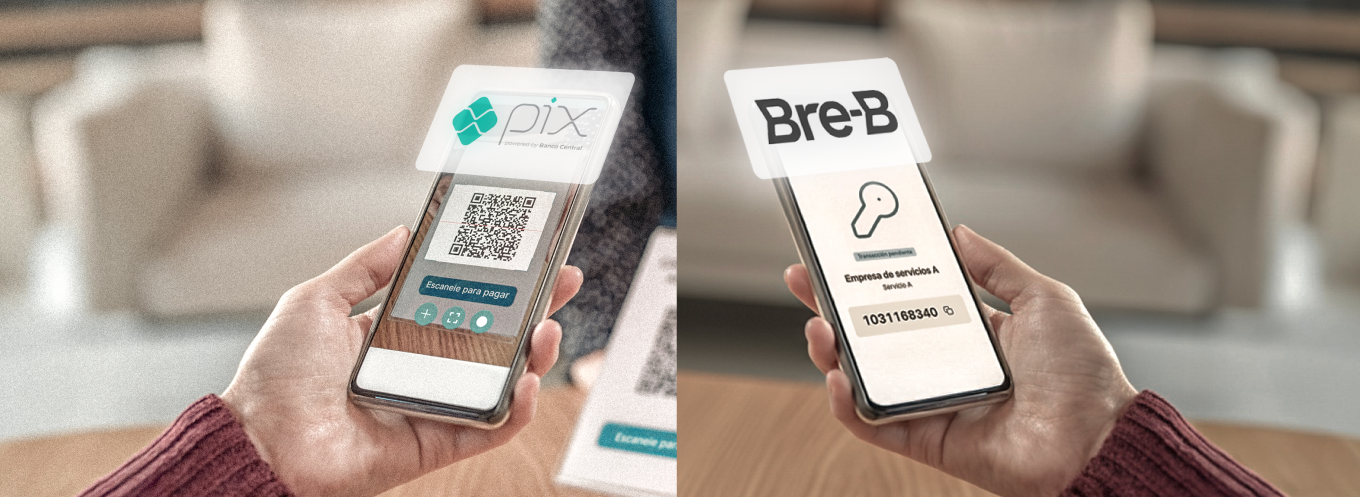
Bre-B (instant interbank payments)
With Bre-B, you can collect payments in scenarios where immediacy and near-real-time reconciliation are key—even if the payments are spread across different banks.
Advantages:
- Aligned with the trend toward instant payments and greater interoperability.
- Potential to improve the customer experience and cash flow.
Credit and Debit Cards
These are payments made with cards issued by local or international banks. They are common in e-commerce businesses that offer digital services, subscriptions, and low-to-medium-value impulse purchases.
Advantages:
- Fast and familiar checkout experience.
- Possibility of additional features (tokenization for recurring payments, card saving, etc., depending on the provider).
- Increases mobile conversion if the form is short.
Checkout Orchestration Recommendations
- Smart payment method ordering: Display the methods most frequently used by your audience first (based on analytics) and keep the alternatives visible.
- Clear messages for each method: Explain what will happen when selected (“We’ll redirect you to your bank/app,” “You’ll see a confirmation upon completion”).
- Continuous A/B testing: Evaluate layout, text, and microcopy. Small changes in the above-the-fold area of the checkout can improve conversion.
- Monitoring and fallback: If a payment method is intermittent, allow users to easily switch to another option without losing their cart.
- Reconciliation and reporting: Tag each payment link with the media source and campaign to measure performance and facilitate accounting closings.
What to Look for When Choosing a Payment Link Provider?
Based on the experience of teams specializing in digital payment processing for businesses, these are the criteria that make all the difference:
- Coverage and availability. Links that work 24/7, with high stability and consistent response times.
- Payment options. Support for various payment methods.
- Transaction data and reports: The ability to search for transactions, apply filters, export data, and receive real-time notifications.
- Integrations. The ability to connect APIs for checkouts, CRM, ERP, or automated workflows, as well as webhooks to update statuses.
- Support and guidance. An onboarding process, best practices, adoption materials, and a team that responds when you need them.
- Compliance and security. Industry standards, anti-fraud controls, and end-to-end traceability.
At Cobre, for example, the vision centers on interoperability, immediacy, and operational control for businesses: ensuring money moves faster, with greater visibility and less friction, while your team reduces manual tasks and reconciliation errors.
Why Cobre’s payment links outperform other solutions?
Payment links let you collect payments wherever your customers are, with fewer steps and more control. Their versatility in offering different payment channels, their ease of implementation, and their ability to integrate with your operations make them a real growth driver for SMEs and large companies alike.
When you use them through Cobre, you get benefits such as:
- Instant payments 24/7/365: your business never stops.
- Direct integration with local payment channels: customers pay through their bank’s or digital wallet’s gateway, with no extra intermediaries.
- Total flexibility in payment methods: choose the payment channel for each transaction (e.g., PSE for transfers, Nequi for digital wallets).
- Greater control over the experience: design your own checkout flow and confirmation screens, without relying on Cobre’s interface.
- Real-time visibility and instant monitoring of every transaction via Webhooks: receive notifications when funds are credited and update your systems instantly.
- On-demand reports: download your transaction data with filters and
Ready to boost your revenue with payment links? Let’s talk and start collecting payments quickly, securely, and hassle-free.