














What is bank reconciliation in Treasury?
Bank reconciliation is the financial control process that ensures your accounting balances accurately reflect the reality of your bank accounts and their transactions.
This process is essential for identifying discrepancies in a timely manner, maintaining accurate cash flow, and providing your finance team with full visibility into the organization’s actual liquidity.
Broadly speaking, the reconciliation process involves collecting information for a specific period, comparing the income and expenses recorded in internal accounting against bank statements, adjusting pending transactions or fees, and closing the balance.
How do you perform an account reconciliation?
Performing a bank reconciliation involves comparing your company’s internal financial records with the statements issued by the bank to ensure that the balances match, verifying each transaction.
Elements of an accounting reconciliation
Every reconciliation involves comparing three key elements:
- Book balance: What your internal records show (ERP, accounting system, or even spreadsheets).
- Actual balance: What external sources indicate (bank statements, supplier confirmations, customer statements).
- Differences and their causes: Discrepancies between the two, which may be temporary (payment in transit) or permanent (recording error, omission).
Step-by-Step Guide to Performing a Manual Bank Reconciliation
Follow these steps to set up your company’s account reconciliation:
- Gathering information: Download your bank statements and prepare the report from your general ledger (or ERP) for the exact same period.
- Compare income: Verify that all deposits, received transfers, and collections reflected in the bank statement match your internal accounts receivable records.
- Review expenses: Compare payroll payments, payments to suppliers, and other operating expenses recorded in your system with the debits on the bank statement.
- Identify discrepancies: Detect and record pending transactions (payments issued but not yet processed by the bank), bank fees, taxes, or rejected transactions.
- Documentation: Update the accounting records with the missing transactions so that the adjusted balance matches the actual bank balance exactly.
Benefits of Reconciliating Accounting Accounts
Account reconciliation is not just a routine accounting process, but a strategic tool for maintaining your company’s financial health.
However, performing manual reconciliations in an age of automation is inefficient and prone to errors.
Performing this process consistently—and preferably with the support of automation tools like Cobre Connect—provides direct benefits to your company’s treasury:
Cash flow visibility and control
Keeping accounts reconciled gives finance teams a unified and accurate view of the company’s actual liquidity.
By centralizing data, you eliminate uncertainty about available funds and ensure that your business resource planning is based on a single source of information.
Reduction in Manual Work and Operational Savings
By structuring and automating transaction reconciliation, companies drastically reduce the operational burden on their teams. Using platforms that centralize bank reconciliation can cut the time spent on this task by up to 70%, saving companies up to 50 hours a month in managing and reviewing payments.
Timely detection of errors and discrepancies
Constantly cross-referencing internal accounting records against bank transactions allows discrepancies to be identified instantly.
This facilitates the detection of duplicate payments, unrecorded bank fees, or pending transactions that the bank has not yet processed, mitigating operational risks and preventing fraud.
Acceleration of month-end closing
Efficient reconciliation eliminates the classic bottlenecks at the end of each period. By keeping records up to date and relying on standardized reports (exportable in formats such as CSV, JSON, or PDF), your finance team can align treasury systems and the ERP to close the books quickly, seamlessly, and error-free.
What are the types of account reconciliation?
There are various reconciliation processes that companies use to maintain the financial health of their operations:
- Bank reconciliation: A direct comparison of bank statements with the company’s internal accounting records.
- Accounts receivable reconciliation: Verification of issued invoices against deposits and payments actually received from customers.
- Accounts payable reconciliation: Verification of supplier invoices against outgoing payments made by the company.
- Intragroup reconciliation: Adjustment and cross-checking of balances between different subsidiaries or entities within the same corporate group.
- Inventory reconciliation: Comparison of available physical inventory against the theoretical record in the accounting system or ERP.
Sample Format for Bank Reconciliation
While there may be different versions of a bank reconciliation format, they generally follow a structure that breaks down the balance by bank and by the books.
What are the challenges of non-automated account reconciliation?
As transaction volumes and the number of banking relationships increase, companies face fragmented processes, for which manual reconciliation can be inefficient and error-prone.
Cross-platform operation
Reliance on multiple banking portals forces treasury teams to manage different logins to download statements from each institution.
This fragments the information and turns reconciliation into a manual exercise of visually matching lines or using spreadsheets.
Lack of traceability in money transfers
In traditional business-to-business payments, reference codes are often open-ended, inconsistent, or constantly reused.
Supporting documentation is frequently sent via email or as a PDF, forcing the receiving team to manually investigate who paid, how much, and which invoice the payment corresponds to, thereby increasing the risk of applying the payment to the wrong customer.
In Colombia, Cobre has launched a solution for managing collections with Transfer-In or businesses.
Lack of visibility and disconnect with the ERP
Without direct integration, there is a significant time gap between when the money enters the bank and when it becomes available and reconciled in the system.
This disconnect creates bottlenecks that lead to slow accounting closings and delay visibility into the organization’s actual liquidity.
Manual reconciliation vs. automation
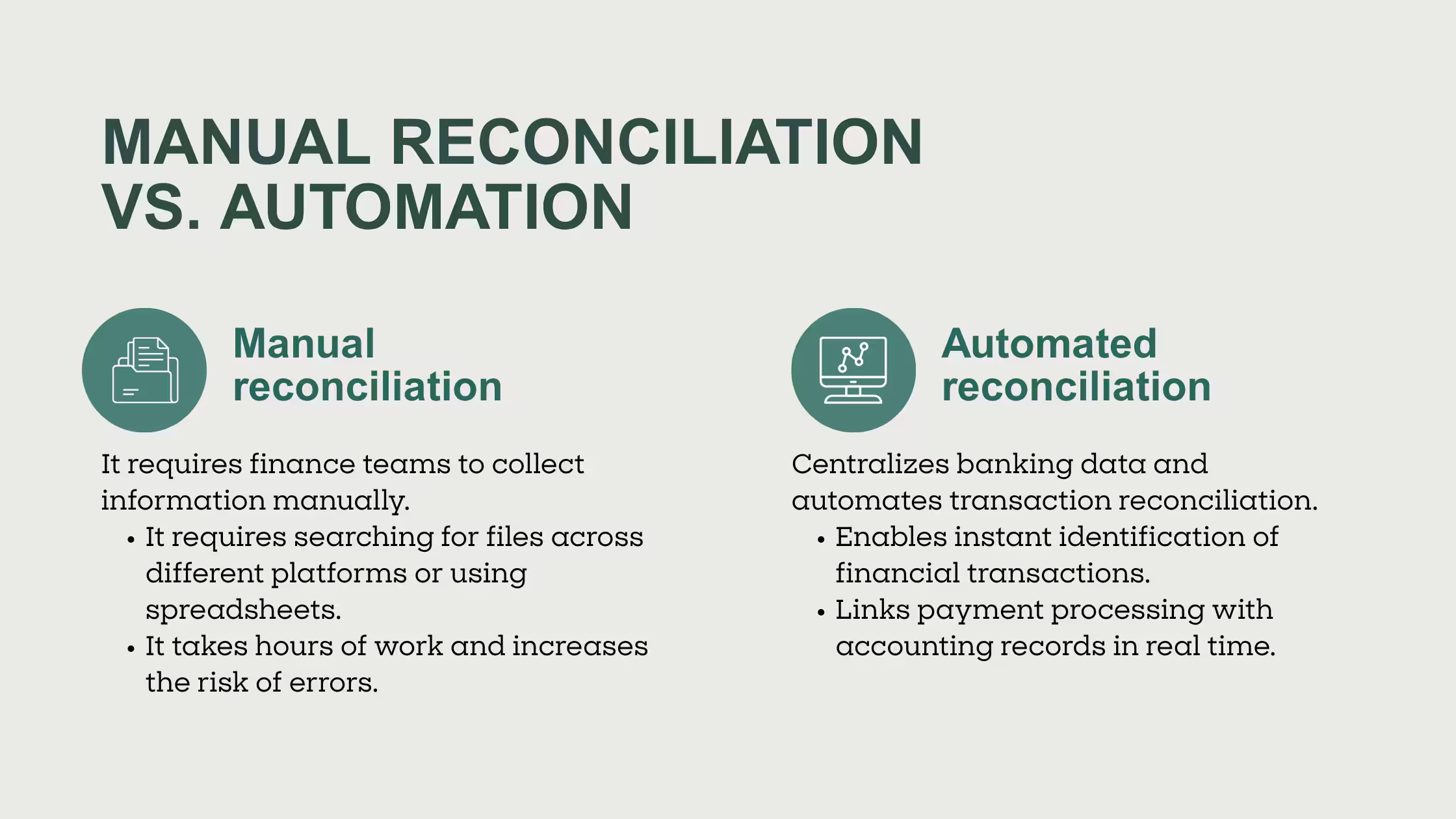
Manual reconciliation forces finance teams to download files from different platforms and match entries visually or using spreadsheets, which takes hours of work and increases the risk of errors.
In contrast, automated reconciliation centralizes banking data and automates transaction matching.
Using API connections or unified platforms, the technology enables instant identification of cash flows, structuring the information and linking payment execution with accounting records in real time.
How can you automate bank reconciliation?
Bank reconciliation can be automated by transitioning from manual processes to technological solutions that link payment processing with accounting records, such as payment infrastructures.
With modern payment platforms like Cobre, you can automate this process using the following tools and methods:
- Multi-bank centralization (Cobre Connect): This allows you to access standardized transaction data from all your banks in one place, automating interbank reconciliation and eliminating the need to download statements from multiple individual portals.
- Automated ERP integration: Through models such as the "Outbox Template," the ERP sends payment instructions and automatically imports status reports to immediately update the status of accounts payable or receivable (completed, rejected, or returned), without manual intervention.
Cobre Connect can also connect to your ERP system, allowing you to view your actual balance and transaction history all in one place.
- Event-based notifications (Webhooks): Every time a transaction is settled or a balance changes, you receive a real-time webhook notification. This acts as a reconciliation trigger, automatically syncing transaction impacts directly into your internal accounting books.
- Use of structured standardized reports: The platform automatically generates transactional reports with clear metadata and references in formats such as JSON, CSV, or PDF.
Implementing these automations eliminates uncertainty about available funds and reduces administrative workload.
Automate your financial reconciliation with Cobre Connect
Transform your treasury management by connecting and centralizing multiple bank accounts from different financial institutions on a single platform.
With Cobre Connect, your company gains unified visibility into account and transaction data, allowing you to manage payments and optimize interbank reconciliation without having to log into individual portals.
Avoid fragmentation and access standardized reports that speed up month-end closing, managing your multi-bank strategies with full control and security.
FAQ’s about Bank Reconciliations
Is reconciliation legally required?
Reconciliation is not directly required by law. However, it is essential for complying with tax obligations and passing audits, and it is also key to the company’s financial health.
Accounting regulations require that financial statements, financial reports, or financial records present a true and fair view of the company, which you cannot guarantee without a rigorous reconciliation.
How often should my company perform bank reconciliation?
It depends on your transaction volume.
- High volume: daily or weekly.
- Medium volume: biweekly.
- Low volume: monthly.
With modern platforms that offer continuous visibility, you can maintain constant monitoring and investigate exceptions as they arise.
What should I do when I find permanent differences?
Permanent differences require immediate accounting adjustments. Investigate the cause, document what caused it, make the necessary journal entry, and implement controls to prevent it from happening again.
How much should a technology solution cost?
Financial management platforms vary in cost depending on volume, the number of bank accounts, and the complexity of integrations.
The key is to evaluate the ROI by considering not only the direct cost but also the reduction in errors and the time saved.
Can I integrate a treasury platform with my current ERP?
Yes. Modern platforms offer integrations with leading ERPs: SAP, Oracle, and Microsoft Dynamics. These integrations can be native, via API, or through standard file formats.

