














What is SPEI and How Does It Work? Complete Guide
For companies expanding into Mexico or managing Mexican operations from the US or Canada, understanding the local payment infrastructure isn't optional. It's fundamental to operating efficiently in Latin America's second-largest economy.
SPEI processes billions of transactions annually, moving trillions in value through Mexico's banking system. If your company pays suppliers, processes payroll, or collects payments in Mexico, SPEI is already part of your operations.
This guide explains what SPEI is, how it works, and why North American companies doing business in Mexico need to understand it to compete effectively.
What is SPEI? Understanding Mexico's Real-Time Payment Infrastructure
SPEI (Sistema de Pagos Electrónicos Interbancarios) is Mexico's electronic payment system, operated by Banco de Mexico, the country's central bank. Think of it as Mexico's equivalent to the US ACH network, but with a crucial difference: SPEI settles payments in real time, not days.
The system connects every licensed financial services and institution in Mexico through a centralized infrastructure. When a company initiates a SPEI payment, funds move from the sender's account to the recipient's account in seconds. This happens regardless of which banks are involved, what time it is, or whether it's a weekend or holiday.
For US and Canadian companies accustomed to multi-day ACH transfers or expensive wire services, SPEI represents a fundamentally different approach to business payments.
Key Features That Make SPEI Essential for Business
Instant settlement
SPEI completes payments in under 20 seconds. Your supplier in Monterrey receives funds the moment you approve the payment from your office in Dallas or Toronto. There's no batch processing, no overnight holds, no "next business day" delays.
24/7/365 availability
Unlike traditional banking systems that operate on business day schedules, SPEI never stops. You can process payroll at midnight on Sunday or pay an urgent supplier invoice on a holiday.
Universal interoperability
Every bank in Mexico connects to SPEI. Whether your treasury account is with BBVA, your payroll runs through Citibanamex, and your supplier uses a regional credit union, the payments work identically. One standard, one network, zero compatibility issues.
Irrevocable transactions
Once SPEI executes a payment, it's final. This eliminates the chargeback risks and settlement uncertainties common in other payment methods. For treasury managers, this means definitive reconciliation without provisional credits.
Complete traceability
Every SPEI transaction receives a unique tracking number that follows the payment from initiation through settlement to final confirmation. When your CFO asks "did the payment go through," you have a definitive answer in real time.
How Does SPEI Work? The Technical Process Simplified
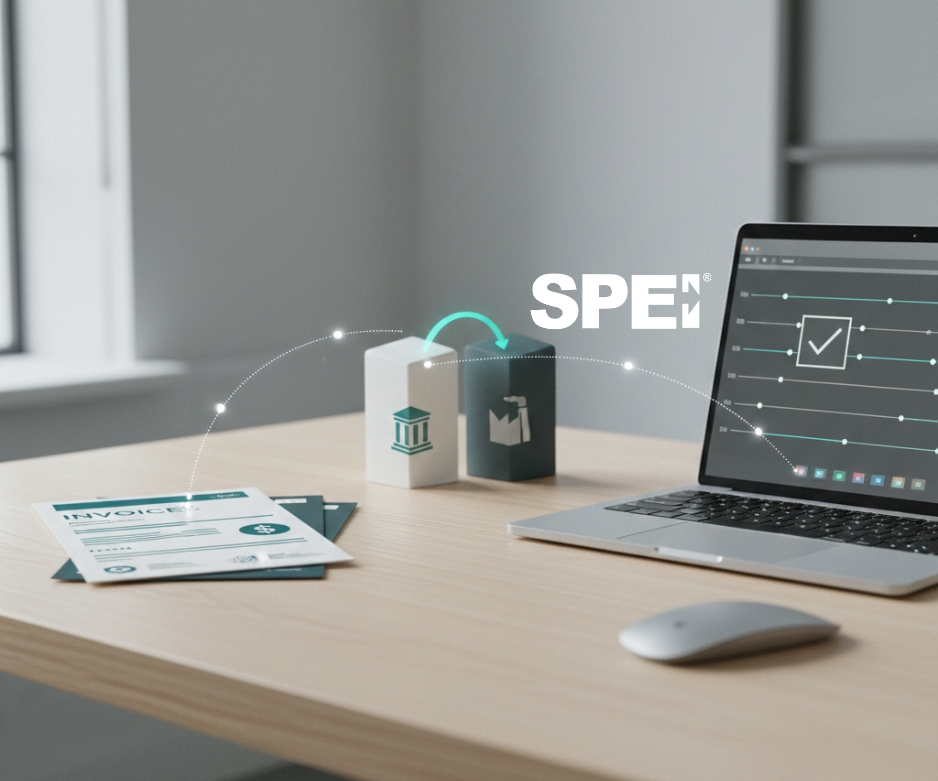
The elegance of SPEI lies in its directness. Where traditional payment systems route transactions through multiple intermediaries, each adding time and cost, SPEI creates a straight line between sender and recipient through Banco de México's central infrastructure.
The 5-Step Journey of a SPEI Payment
Step 1: Transaction initiation
Your company's bank receives your payment instruction, whether through their portal, a payment file, or an API call. The bank validates that your account has sufficient funds and that the payment details are correctly formatted.
Step 2: Central system transmission
Your bank sends the payment message directly to Banco de México's SPEI infrastructure. This isn't a request or a batch file to be processed later. It's an immediate execution instruction transmitted over dedicated, secure networks.
Step 3: Real-time validation and routing
Banco de México's system validates the transaction for fraud prevention, confirms the recipient's bank account exists and can receive funds, and verifies regulatory compliance.
Step 4: Immediate settlement
Banco de México adjusts account balances between the sending and receiving banks instantly through their reserve accounts. The funds move the moment the validation completes.
Step 5: Confirmation to both parties
Both banks receive immediate confirmation. Your bank updates your account balance and sends you a confirmation with the unique transaction ID. The recipient's bank credits their account and notifies them.
Compare this to traditional wire money transfers. The system works through intermediary institutions: your originating bank transfers to correspondent banks that handle currency exchange and regulatory checks, route it through messaging systems, and finally deliver funds to the recipient's bank. Each intermediary adds potential failure points, cost, and time scales.
Understanding CLABE: Mexico's Banking Account Identifier
Every bank account in Mexico has a CLABE (Clave Bancaria Estandarizada), an 18-digit standardized account number that serves as the routing address for SPEI payments.
The structure breaks down as:
- 3 digits for the bank code
- 3 digits for the branch
- 11 digits for the account number
- 1 check digit for validation
This standardization means you don't need to know which bank or branch holds an account. The CLABE contains all routing information.
For companies processing hundreds or thousands of Mexican payments monthly, proper CLABE management becomes critical. A single digit error doesn't result in a mis-routed payment days later. SPEI rejects invalid CLABEs immediately during validation.
Why Use SPEI? Benefits for Business Operations
The technical capabilities of instant settlement and 24/7 availability translate directly into operational and financial advantages.
Operational Efficiency Gains
Traditional payment options force companies to plan around banking schedules and processing delays. SPEI eliminates this artificial time management.
Your accounts payable team can approve supplier invoices as they're verified, not batch them for the next payment run. Your treasury manager can move funds between Mexican accounts without worrying whether the transfer will complete before market close.
Financial Performance Impact
The treasury impact compounds over time. Better collection timing reduces working capital requirements, which reduces financing costs. When customers know their payment settles instantly, payment behavior often improves.
Instant settlement enables dynamic payment timing. Instead of paying suppliers early to ensure on-time arrival or paying late to preserve cash, companies can pay exactly when optimal.
Business Use Cases Across Industries
Fintechs and payment service providers
Rather than spending months building payment rails, companies can leverage SPEI to offer instant payment services to their customers. Payment platforms entering the Mexican market use SPEI connectivity to launch services faster than building proprietary infrastructure would allow.
Companies with cross-border operations
Businesses operating between North America and Mexico benefit from integrating SPEI into their broader treasury operations. Processing local Mexican supplier payments through SPEI while managing US dollar payables creates a complete view of cash position across currencies.
Enterprise treasury departments
Companies managing multiple Mexican bank accounts face exponential complexity as they scale. Three bank accounts mean three portals, three reconciliation formats, three security protocols.
BPOs and service companies
Organizations processing large-scale payroll find SPEI transforms their operations. Previous processes involving preparing payment files, uploading to multiple banks, and monitoring for failures get replaced by automated workflows with real-time confirmation.

SPEI vs Other Payment Methods: When to Use Each
SPEI versus traditional wire transfers
Wires through correspondent banking networks take one to two business days and carry substantial per-transaction costs. SPEI settles in seconds and typically cost-effective. Reserve wires for situations requiring currency conversion or routing to banks outside Mexico's SPEI network.
SPEI versus CoDi
CoDi is Mexico's QR-code based instant payment system, primarily designed for consumer payments. While both use instant settlement, SPEI handles business-to-business transactions, bulk payments, and enterprise-scale volumes.
SPEI versus card payments
Card processing carries percentage-based fees and settles in multiple days. SPEI costs a flat transaction fee regardless of amount and settles instantly. For B2B transactions, SPEI's economics are substantially better.
When SPEI is optimal
Any business payment where both parties have Mexican bank accounts:
- Supplier payments
- Payroll processing
- B2B collections
- Inter-company transfers
- Contractor payments
- Rent and utilities
How to Optimize SPEI for Your Business: From Complexity to Competitive Advantage
Companies beginning Mexican operations often start with bank portals, assuming they'll work like US business banking. Bank portals designed for individual users or small businesses break down at enterprise scale.
The Enterprise SPEI Challenge: Why Manual Management Doesn't Scale
Most Mexican enterprises operate accounts with three to six different banks. Companies maintain relationships for historical reasons, regulatory requirements, geographic coverage, or specific services.
Each bank relationship means separate access, different interfaces, distinct security protocols, and unique data formats.
The operational reality
A typical payment workflow involves logging into Bank A's portal to pay suppliers, then Bank B's portal for payroll, then Bank C's for another set of vendors. Each portal has different processes despite SPEI running 24/7.
The reconciliation challenge
Each bank provides transaction data in its preferred format. Bank A sends CSVs with certain columns in one order, Bank B sends Excel files with different columns in another structure, Bank C provides PDFs requiring manual data entry.
Matching these transactions back to your ERP's accounts payable or receivable records becomes a manual mapping exercise.
Real-time visibility becomes impossible
At any moment, can you answer "what's our current peso balance across all Mexican accounts?" Not without logging into multiple portals and manually summing the numbers.
This lack of consolidated visibility forces companies to maintain higher buffer balances than necessary.
Modern Approach: Centralized SPEI Infrastructure
Companies solving the multi-bank challenge implement unified payment infrastructure that connects to SPEI through all their Mexican banks via a single integration point.
Single API access across all Mexican banks
Instead of maintaining multiple separate bank relationships at the technical level, treasury systems connect once to payment infrastructure that handles the routing to each bank. The platform manages the specific integration requirements, dataset format translations, and authentication protocols for each institution.
Real-time visibility and control
Consolidated dashboards transform treasury operations. Instead of logging into multiple portals to check balances, view pending transactions, or initiate payments, treasury managers work from a single interface showing current positions across all accounts.
This visibility enables confident cash management decisions:
- Moving funds between accounts to optimize balances
- Making payment decisions based on actual available funds
- Managing liquidity dynamically rather than defensively
Automated workflows
Direct integration with ERPs means approved invoices automatically flow to payment execution. Payment confirmations automatically flow back to the ERP for reconciliation.
Selecting the Right Infrastructure Partner
Not all payment platforms are built equal. Companies evaluating infrastructure partners should focus on several critical criteria.
Direct bank connectivity
Some platforms act as intermediaries, routing payments through their own accounts rather than directly from your accounts through SPEI. Look for platforms with direct connections to Banco de México's SPEI infrastructure through each participating bank.
Proven uptime and performance
Your payment infrastructure should maintain high availability. Response times matter for operational efficiency. Platforms processing payments quickly enable real-time workflows.
Security certifications
Key certifications to look for:
- ISO 27001 for information security management
- PCI DSS for payment industry standards
- SOC 2 for service organization controls
Comprehensive API documentation
Your engineering team should be able to implement the integration without excessive consultation. This separates platforms built for enterprise integration from those adapted from consumer-facing products.
Batch and individual payment capabilities
Some payments need immediate individual execution. Others make sense as batch operations. Infrastructure that handles both patterns eliminates the need for multiple systems.
Real-time notifications
When a payment settles, your systems should know immediately without polling for status. This enables automated downstream processes.
Regional expertise for multi-country operations
For companies with operations beyond Mexico, regional capabilities become valuable. Orchestration payment platforms built specifically for Latin America offer integrated access to SPEI alongside similar instant payment systems in other markets.
This means companies can manage Mexican local operations and regional expansion through a single infrastructure rather than assembling separate vendors for each country.
Modern payment infrastructure connects to real-time payment systems across the region, from Mexico's SPEI to Colombia's Bre-B, enabling centralized treasury management regardless of geographic footprint.
The question to ask potential partners: "If we're processing both local Mexican payments and international transactions, can your platform handle both, or will we need separate vendors?"
Platforms that integrate local payment capabilities with international payment solutions create complete treasury management systems.
Organizations operating across Latin America benefit from unified infrastructure that connects bank accounts in both Mexico and Colombia, providing a single point of control for regional treasury operations.
SPEI as Strategic Infrastructure
SPEI is essential infrastructure for competing in Mexico's digital economy. Companies that optimize their SPEI operations gain measurable competitive advantages: faster cash conversion cycles, reduced operational costs, and the ability to scale without proportional increases in finance team workload.
The question isn't whether to use SPEI, but how efficiently you're leveraging it.
Whether you're processing payroll for thousands of employees, managing supplier payments across multiple banks, or scaling your fintech platform, the right payment infrastructure turns SPEI complexity into simplicity.
For North American companies building or expanding Mexican operations, understanding SPEI is table stakes. Optimizing it is a competitive advantage.
Processing SPEI payments across multiple Mexican banks?
Modern payment infrastructure can help you centralize operations, automate reconciliation, and process payments faster while reducing operational complexity.
Discover how leading companies optimize their Mexican payment operations with unified API access to SPEI across major banks.